

Customer experience is where the revenue is
We can all agree that the traditional marketing funnel is not linear anymore and that digital media and more recently LLMs have upended the conventional “path to purchase”. Whichever way people get there though, there is movement, no matter how swift from awareness to understanding and then onto consideration and ultimately to purchase and re-purchase. Because it is easier, marketing budgets are often still being poured into creating visibility and awareness but we know that South African consumers are making their buying decisions somewhere else entirely.
Walk into most marketing planning sessions and you will hear plenty about reach, awareness and which influencer is right for the next campaign. You will hear far less about the out-of-stock that sent a loyal customer to a competitor, or the refund that took six weeks and led to a customer leaving you forever. Yet the 2026 South African Customer Experience Report, which I co-author with Charlie Stewart of Rogerwilco and CX consultant Julia Ahlfeldt, shows that it is the second conversation that is actually moving money.
Influencers can and do catch many eyes, but when a cash-strapped consumer is deciding whether to part with their hard-earned rands, they are not looking at a sponsored reel. They are reading what other customers say happened to them.
Social proof beats social reach
When we asked 2 000 online South Africans which information sources they find most helpful when looking for products or services, customer reviews on a company’s website came out on top at 58%.1 In this consideration phase, recommendations from friends and family followed at 51%, and independent review platforms such as HelloPeter were chosen by 44%.
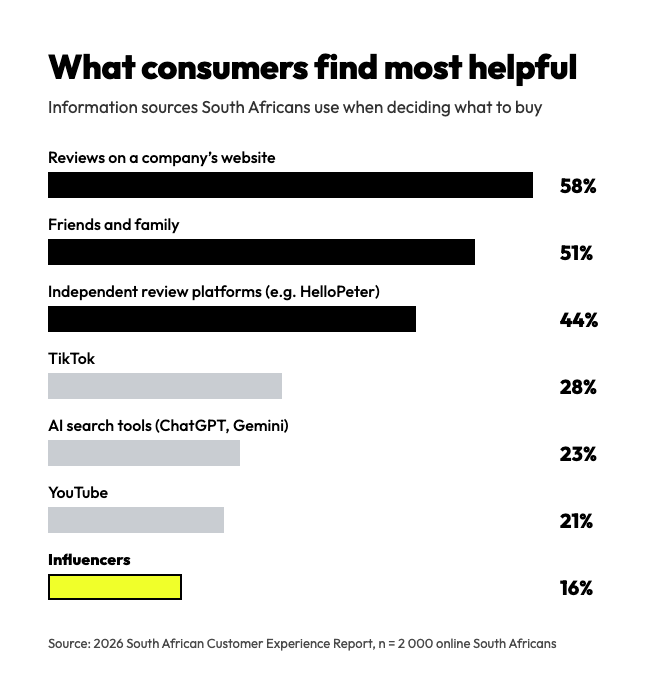
Influencers were selected by just 16%. That is fewer than TikTok (28%), YouTube (21%) and even the AI search tools such as ChatGPT and Gemini (23%) that most consumers only started using in the last year or two.
This is not an argument that social media is dead. Platforms like Facebook, TikTok and YouTube still play a real role in awareness and discovery, but our data suggests that when consumers move from browsing to deciding, they shift towards sources they see as more credible and more relevant to the question in front of them. Reviews and recommendations help people reduce uncertainty before they commit, and right now uncertainty is expensive.
That matters more than ever because consumers are under pressure. Seventy-two percent of this year’s sample told us their financial position had stagnated or worsened over the past year, and 21% had dipped into savings or pension funds to cover monthly expenses. Value for money was the single biggest factor bringing consumers closer to a brand, cited by 71%. As my co-author, Julia puts it, every purchase is now a high-stakes calculation. People in that position do not want to be dazzled. They want to be reassured that they will not regret the decision.
Business is looking in the wrong place
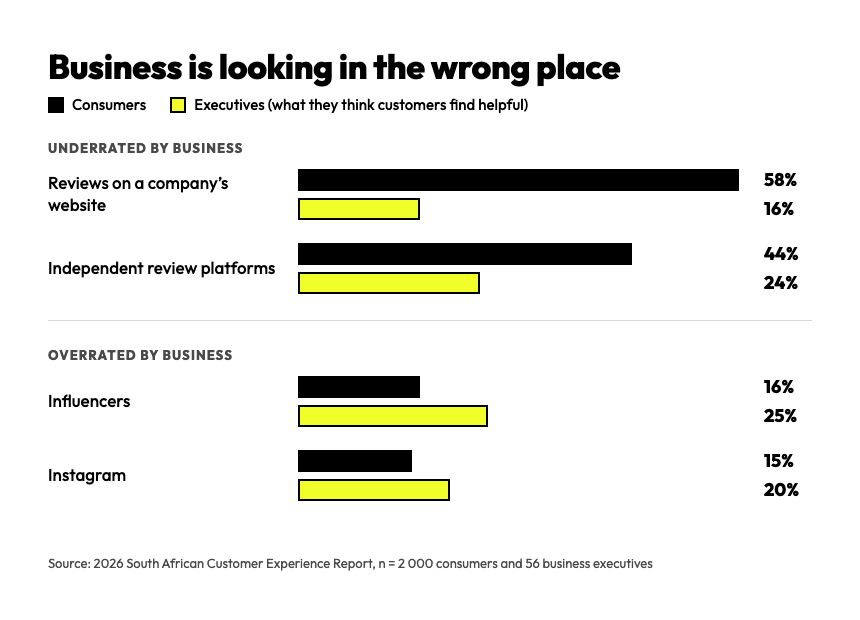
The most revealing finding was not how consumers behave, but how differently businesses believe they behave. We put the same question to 56 business executives, most of them in senior marketing and CX roles.
Only 16% of executives thought customers find reviews on the company’s own website helpful, against 58% of consumers. Independent reviews were rated by 24% of executives versus 44% of consumers.
Meanwhile, the executives overestimated influencers: 25% believed they were among the most helpful sources, compared with 16% of consumers. Instagram showed the same pattern, at 20% against 15%.
The uncomfortable truth: you can’t brief your way to good reviews
I understand why the influencer route is attractive. You can write a brief, agree a fee, get the content approved and report on views and clicks within a fortnight. It is clean, contained and measurable and also really visible; your friends and family are high-fiving you for the new campaign.
Good reviews do not work like that. A review is simply a customer reporting on whether the promise was kept. And the things that break that promise are rarely in marketing’s hands. When we asked consumers which hurdles would make them consider taking their business elsewhere, the top answers were hidden fees and long waiting times (both 61%), poor websites and apps (53%), difficult refunds (52%), lack of follow-up (49%) and not being able to reach a person (47%). Not one of those is fixed by a better campaign.
This is where marketers find themselves in an awkward position. Over the past two decades the role has quietly shrunk as I wrote in my chapter about marketers’ demotion. 2 Marketers used to own, or at least heavily influence, product, price and place. Today many are left with promotion, and often only the slice of it that can be measured instantly. Product quality, pricing decisions, stock availability, the app, the contact centre and the delivery promise usually sit in someone else’s department.
So marketers make promises over which they have no control when it comes to delivery, and are then held accountable when sales drop. Strictly speaking, customer experience falls outside marketing’s remit in most organisations. That is exactly why it gets neglected, and exactly why it needs marketing’s voice at the table.
As my co-author Charlie says in this year’s report, the challenge is no longer simply generating awareness. It is making sure that wherever customers encounter your brand, they find evidence that backs up what your marketing promised.
Customer experience where the real work happens
The reason to take on that harder work is simple: it is where retention and growth come from, in both directions.
81% of consumers had a negative experience in the past 12 months, up from 76% in 2024. More than half (55%) have switched away from a brand they used all the time because of a poor experience, and 52% simply stop supporting the organisation. Yet only 24% now post about a bad experience on social media or a review site, down from 50% in 2023. Customers are not complaining louder. They are leaving quietly, and no influencer campaign will win them back if the reason they left is still there.
That silence is also hiding the problem from the people who could fix it. Although 79% of businesses rely on surveys to measure CX, nearly half of consumers (49%) say that after a poor experience they give a neutral score, a higher score than deserved, or ignore the survey altogether. A healthy dashboard can be masking a very leaky bucket.
On the upside, good experiences pay forward. More than 80% of consumers tell friends and family when a brand treats them well, and 55% say they increase the amount of business they do with that brand. Remember that friends and family are the second most helpful source when people decide what to buy. Every well-kept promise is generating the very word of mouth and reviews that our data shows tip purchase decisions. And yes, I’m aware that word of mouth sounds super-retro in the late 2020s.
That is a flywheel no paid post can replicate. Good experiences create reviews and recommendations; those reviews persuade the next customer at the moment of decision. Our report concludes that customer experience is no longer only what happens after someone buys from you. It now decides whether they buy from you at all.
The challenge for 2027
None of this means influencers have no place. They can be a useful spark at the “top of the funnel” but if your budget is weighted heavily towards attention while the experience behind it is broken, you are paying to send people towards a door that disappoints them.
So here is my challenge to marketers heading into 2027:
- Walk the journey before you buy the media. Before the next campaign goes live, try to buy, return and complain as a customer would. If the checkout is clunky or the delivery promise is vague, fix that first.
- Read your reviews like a strategy document. Your own site’s reviews and platforms like HelloPeter tell you which promises are being broken, in your customers’ own words.
- Buy your Head of Operations a coffee. Your results depend on their ability to deliver what you advertise. Align what you promise with what the business can actually keep.
- Measure behaviour (internal and external), not just scores. Track repeat purchase, retention and switching alongside NPS and CSAT, and treat silence as a warning, not a compliment.
- Leave your desk: too many organisations operate in a vacuum, looking only internally at their own NPS scores and behavioural stats without looking outside to competitors but even more importantly to the actual end-user themselves. As I said in the report, “It is perilous to rely on a single score to understand how customers feel about your brand”, you need to understand your brand in the context of a customer’s broader life and choices.
Fixing customer experience is harder, slower and messier than briefing an influencer. It means working across departments you do not control. And yet, this is the work that retains customers, grows their spend and turns them into the most persuasive marketing channel you have. In a pressure economy, trust is the currency, and it is earned in the experience, not bought in the feed.