

SEO problems don’t appear out of the fog, waving red flags all at once. There’s usually no dramatic collapse in stats, no sudden disappearance from the SERP, and no obvious signal telling you something (or what) is broken. Performance simply becomes harder to explain. The signs are there when traffic plateaus, visibility gradually weakens and leads become less consistent. Pages that used to perform well lose their traction without a clear reason why.
This is where many businesses become frustrated with SEO.
From the outside, everything appears active. Content is still being published regularly, rankings may still look relatively stable, and reports still show movement. Yet the overall impact feels far weaker than it should. In many cases, the issue is that the SEO structure has weakened over time.
This is one of the most overlooked realities in modern SEO. Visibility isn’t built through isolated tactics alone. It’s shaped by how effectively content, authority, technical performance, trust signals, and site structure reinforce one another.
Most SEO decline is structural before it becomes visible.
Why Random Publishing Quietly Weakens SEO Authority
One of the most common SEO mistakes businesses make is assuming that publishing more content will naturally improve visibility. It sounds like a logical solution on the surface. More articles should create more opportunities to rank, attract traffic, and build authority. In practice, that’s rarely how strong SEO performance develops.
Content without structure often creates fragmentation instead of authority.
Many businesses publish reactively rather than strategically. Topics become disconnected, internal linking is inconsistent, and multiple pages start competing for overlapping intent without reinforcing one another. Over time, the website expands, but its topical authority weakens because search engines struggle to identify what the business should genuinely be trusted for.
We see this problem arise more frequently as AI-driven search environments dominate the space.
Search engines and AI systems rely on contextual understanding to evaluate expertise. Random publishing patterns create weak topic reinforcement, while connected content ecosystems build stronger authority signals over time.
The difference is subtle, but important: random articles fill space, structured content builds visibility.
Authority Is Built Through Consistent Reinforcement, Not Volume
Strong SEO strategies reinforce expertise repeatedly across related topics.
A property developer publishing consistently around financing, investment trends, location insights, and buyer considerations creates a much clearer topical authority profile than one producing disconnected content around generic business or lifestyle trends. Over time, this consistency helps search engines understand not just what the business offers, but the specific areas it should be trusted to speak about.
This is where many content strategies quietly lose their momentum.
Businesses often focus heavily on producing content while giving less attention to content relationships, topic hierarchy, and authority reinforcement. The result is a growing library of pages that generate activity without strengthening long-term visibility.
Many businesses don’t have content gaps. They have content without structure.
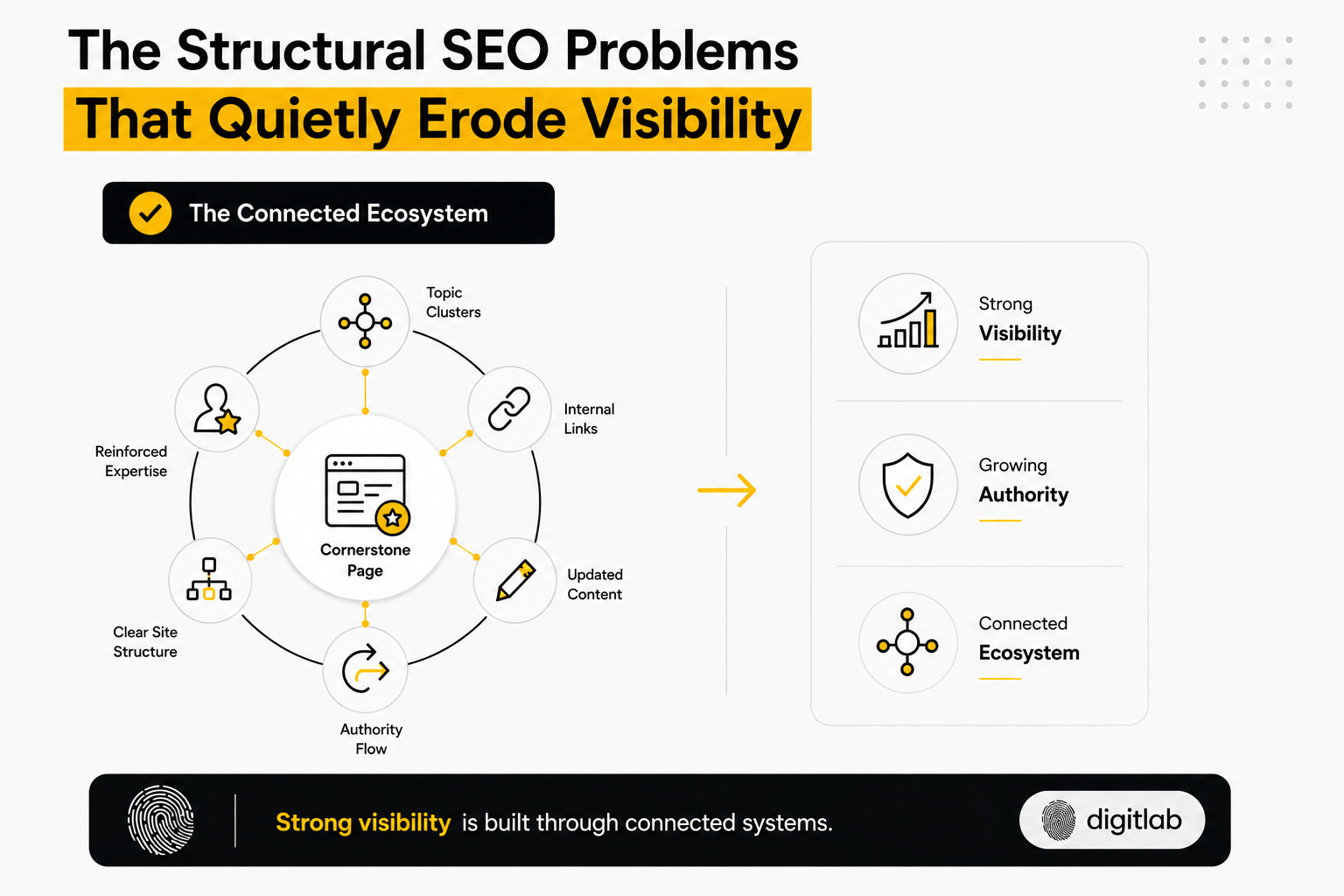
Your Cornerstone Content Should Lead, Not Just Exist
Most websites have cornerstone pages. Very few have cornerstone pages that lead topics. A strong cornerstone page does more than target a competitive keyword. It establishes topical authority, creates contextual structure, and guides users toward deeper understanding and commercial intent.
Weak cornerstone content makes the entire SEO system harder to reinforce, because supporting pages lose contextual direction. Articles start targeting similar intent without strengthening a central authority page, internal linking becomes inconsistent, and topic clusters start functioning like isolated assets rather than connected systems. Over time, this weakens topical authority significantly. Search engines can see the content exists, but struggle to understand which pages should lead the topic and how expertise is reinforced across the broader website.
This is one of the reasons many businesses struggle to build sustainable SEO performance. The content exists, though the structure connecting it does not.
Cornerstone Pages Should Create Direction Across the Website
A strong cornerstone page typically performs three important roles simultaneously:
- Anchoring a broader topic strategically
- Distributing authority to supporting pages
- Guiding users toward meaningful next steps
Without that structure, pages compete for visibility independently instead of strengthening one another collectively. This is where SEO becomes difficult to scale sustainably. Businesses continue adding more content, while the authority architecture underneath it remains fragmented.
The strongest SEO strategies don’t simply create pages. They build connected topic ecosystems where cornerstone pages, topic clusters, and supporting content continuously reinforce expertise across the website.
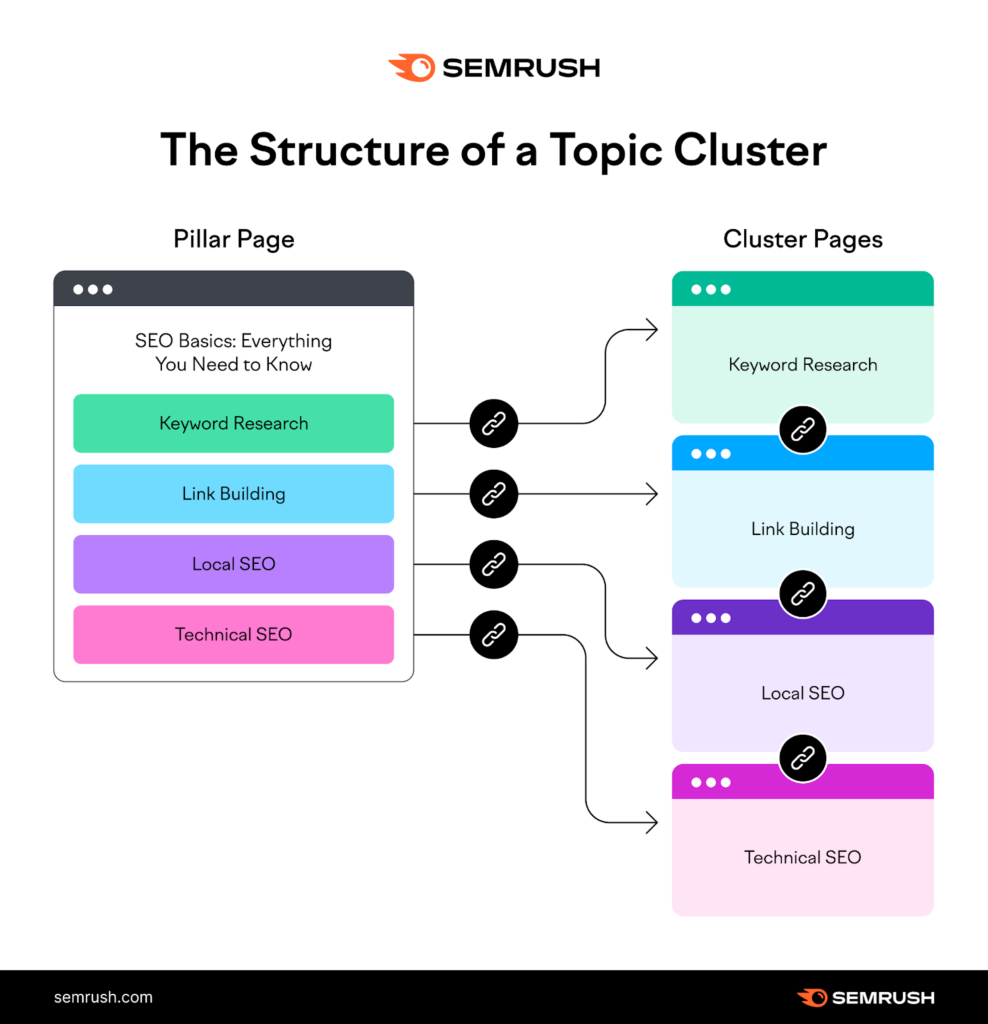
(Pillar Pages and Clusters Explained, Source: Semrush)
Common SEO Mistakes Often Start with Content Written for Rankings
Keywords still matter in SEO. They are important indicators of search intent, topical relevance, and discoverability. The problem comes in when keywords become the entire strategy.
One of the most common SEO mistakes today is producing content designed primarily to capture rankings instead of building trust, usefulness, or authority. These pages are generally technically optimised, though strategically shallow. They target search demand effectively while contributing very little original insight, expertise, or contextual value. This is what creates a visibility problem over time.
Search engines have become significantly better at evaluating quality signals beyond just keyword relevance. AI-driven search is pushing this even further by prioritising content that demonstrates clarity, expertise, consistency, and contextual usefulness – regardless of where those pages rank.
This is why trust is becoming a determining factor in SEO performance.
Content that exists purely to rank may still generate temporary visibility. Content that genuinely helps users, reinforces your expertise, and contributes to broader topical authority systems is far more likely to sustain visibility long term.
Strong SEO Content Helps Users Make Better Decisions
One of the clearest ways to evaluate SEO content today is to look at what happens after someone reads it.
Does this content genuinely help users understand something more clearly? Or is it simply repeating information they could find on dozens of other websites?
A business publishing generic articles answering surface-level questions may generate some visibility, but it rarely builds meaningful authority. Content that explores real customer considerations, common decision-making challenges, or practical industry insights creates a much stronger trust signal because it demonstrates understanding rather than simply targeting keywords.
This is also where E-E-A-T becomes increasingly important. Search visibility is more closely tied to whether content demonstrates genuine understanding rather than simply targeting discoverability opportunities.
Internal Linking Quietly Determines How Authority Flows
Internal linking is one of the simplest aspects of SEO to improve and one of the most consistently neglected. Many websites treat internal linking as secondary formatting decisions rather than strategic authority signals. Internal linking plays a major role in helping search engines understand topic relationships, page importance, and contextual hierarchy across your website.
Without strong internal linking, every page is left to perform largely on its own. This creates structural weakness over time. Important pages don’t accumulate authority properly. Supporting articles become isolated, and search engines struggle to understand how related topics connect across the broader website ecosystem.
Internal linking also shapes user movement. A well-structured internal linking system guides users naturally toward related information, supporting pages, and commercial intent. Weak linking structures create dead ends where engagement quietly drops off – unrelated links or broken links are sure exit points for users.
Technical SEO Problems Often Look Small Until Visibility Declines
One of the reasons technical SEO is frequently underestimated is that most issues start as minor inefficiencies rather than obvious failures. A slightly slower page speed here. An indexing inconsistency there. A growing number of broken links, bloated page structures, weak mobile usability signals, or crawl inefficiencies that appear manageable in isolation.
This is what makes technical SEO difficult for many businesses to diagnose properly. Performance declines are gradual enough that the underlying causes are often missed until visibility has already significantly weakened.
Technical SEO is far more strategic than many businesses realise. Search visibility depends on how easily search engines and AI systems can navigate your site’s structure, interpret relationships between pages, and access content reliably. Weak technical foundations make that process significantly harder over time.
How Technical SEO Quietly Impacts Discoverability
Technical Issue | SEO Impact | AI Search Impact |
Slow page speed | Reduced engagement and crawl efficiency | Slower content processing and weaker accessibility |
Broken internal links | Weakens authority flow | Disrupts contextual relationships between topics |
Poor mobile usability | Lower user experience signals | Harder content interpretation across devices |
Weak site structure | Confuses topic hierarchy | Makes expertise relationships harder to interpret |
Indexing inconsistencies | Pages lose discoverability | Important content may not be surfaced reliably |
Technical SEO affects how easily search engines and AI systems can access, interpret and trust your content.
Technical SEO Creates Stability Long Before It Creates Growth
Strong technical SEO is not about over-engineering websites unnecessarily. Its value comes from consistency. Pages remain accessible, site structures stay interpretable, authority flows efficiently, and content is discoverable without unnecessary friction building beneath the surface.
This is why strong technical SEO foundations often become invisible until they weaken. Businesses forced into constant reactive fixes usually experience far less stable visibility than those maintaining strong technical consistency over time.
Outdated Content Quietly Loses Visibility
Publishing new content is only half the job. One of the most common SEO mistakes businesses make is assuming their older content will continue performing indefinitely once it ranks well. Search environments evolve constantly, your competitors improve pages, user expectations shift, industries change, and search intent develops over time.
Content that performed well can slowly lose relevance without becoming obviously “bad.” This is where we see many visibility declines start.
Older pages can remain technically live while gradually becoming less aligned with current search expectations. Internal links weaken, statistics become outdated, explanations lose their depth, and competing pages become more useful or relevant.
Search Visibility Weakens When Content Stops Evolving
Updating content isn’t just about refreshing publish dates. It is about strengthening authority continuously.
This often includes:
- Improving content clarity and structure
- Expanding topical depth and expertise
- Strengthening internal linking structures
- Aligning content with current search intents
- Reinforcing topical relevance
In many cases, improving a strong existing page will create more visibility than publishing a completely new one. Outdated content gradually fades until stronger competitors replace it.
Visibility Without Context Creates False Confidence
SEO reporting often creates a misleading sense of progress because visibility metrics are easy to mistake for strategic performance. The strategy appears healthy, but businesses still struggle to understand why stronger visibility isn’t translating into stronger authority, better engagement quality, or clearer commercial impact.
This is one of the most common SEO mistakes in modern reporting. Metrics are often evaluated in isolation rather than within the broader context of visibility quality, user intent, engagement, and authority progression. A page attracting traffic from low-intent searches may appear successful in reports while contributing very little strategic commercial value. Another page generating lower traffic but attracting highly relevant users may contribute far more value to long-term visibility and business growth.
Without contextual understanding, SEO reporting becomes focused on activity rather than being strategically useful.
Visibility Quality Matters More Than Visibility Volume
This becomes increasingly important as search evolves. AI-driven discovery environments are prioritising contextual relevance, consistent authority signals, and interpretability more heavily than raw visibility and ranking alone. Businesses focusing purely on traffic growth may miss broader visibility shifts already affecting the quality of their discoverability.
This is one of the reasons modern SEO needs stronger strategic interpretation than it did previously. “Visibility without context creates false confidence. Strategic visibility creates momentum.”
AI Search Is Exposing Weak SEO Structures
AI-driven search isn’t creating entirely new SEO problems. In many cases, it’s just exposing weaknesses that already existed beneath the surface.
Fragmented content structures, inconsistent authority signals, shallow expertise, poor internal linking, and disconnected topic ecosystems become far more visible in AI search environments because these systems rely heavily on contextual understanding and reinforcement. This is where many businesses are realising their SEO foundations were never designed for AI-driven discoverability.
Traditional SEO strategies built around isolated rankings struggle when discoverability is more dependent on clear authority and semantic consistency across broader digital ecosystems.
AI SEO Mistakes Start with Weak Context
One of the most common AI SEO mistakes businesses make is assuming AI visibility can be improved through isolated optimisation tactics alone.
AI systems rely heavily on broader contextual signals:
- Topical reinforcement and depth
- Content relationships and structured linking
- Consistent expertise across channels
- Clear semantic structures between pages
This aligns closely with the shifts explored in answer engine optimisation and generative engine optimisation, where discoverability increasingly depends on how effectively expertise is reinforced and interpreted across connected environments.
AI visibility isn’t built on isolated pages. It’s built through connected authority systems.
SEO Performance Depends on Systems, Not Isolated Tactics
This is where we see so many SEO strategies quietly break down. When businesses approach SEO as a collection of separate activities, the system becomes fragmented. While publishing optimised articles regularly, improving rankings, building backlinks, and fixing technical issues are part of the process, they’re not enough in isolation. They only become effective when they reinforce one another systematically.
This is why SEO should be approached as a system rather than a campaign:
- Content builds authority
- Authority strengthens discoverability
- Discoverability creates insight
- Insight improves strategy
- Strategy reinforces visibility
Break the structure, and performance weakens gradually. This is also why businesses increasingly need an SEO strategy built around connected authority systems rather than isolated ranking tactics alone.
Most Visibility Problems Are Structural Problems
Most businesses don’t have an SEO problem in the way they think they do. They have a structure problem.
Visibility weakens when authority becomes fragmented, content loses its direction, internal linking weakens, technical friction compounds, and strategy becomes disconnected from reinforcement.
This is what makes many common SEO mistakes difficult to identify early. Everything still appears active on the surface while the underlying systems gradually lose their cohesion.
Fix the structure, and visibility becomes easier to sustain. Ignore it, and SEO slowly becomes harder to explain.