

No business sets out to misunderstand SEO.
They invest in it with a clear expectation:
- Increased visibility
- More traffic
- And ultimately, more revenue
On the surface, the indicators often look promising. Rankings improve, organic traffic grows, and reports reflect steady progress.
When those metrics are measured against actual business outcomes, a different picture can emerge.
Leads don’t always increase at the same rate. Sales teams may not feel a meaningful shift in the quality of traffic or enquiries coming through. The connection between SEO activity and revenue becomes difficult to explain. This challenge is reflected more broadly in how businesses approach marketing performance. From what we’re seeing in our latest Insight Report, half of South African organisations still rely on instinct over analytics when making decisions, even as investment in digital continues to grow.
This is where the real question starts to form: what are you actually paying for when you invest in SEO services?
Why SEO Feels Like a Black Box for Most Businesses
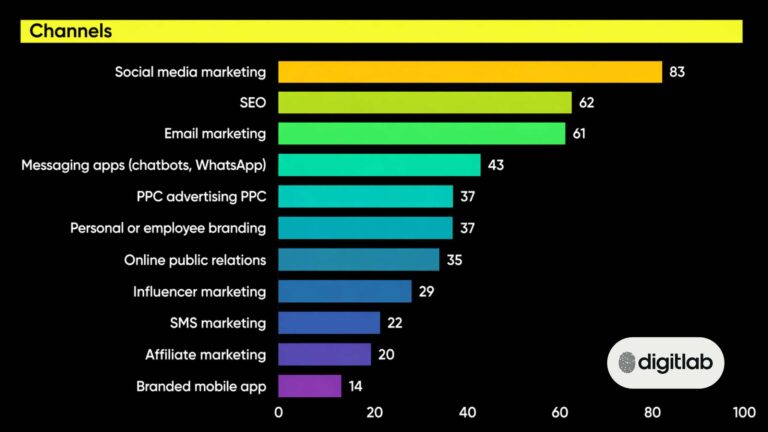
Insight from our State of Digital: Insight 2026 report shows SEO is one of the most widely used digital marketing channels, with roughly 62% of businesses trusting the channel to deliver on marketing objectives – yet it remains one of the most misunderstood.
Many businesses partner with an SEO company in South Africa, expecting a relatively straightforward exchange: investment in, results out. But SEO doesn’t operate with the same immediacy as paid media or direct-response channels. The work happens over time. Changes take longer to reflect. Results are influenced by multiple variables, many of which sit outside direct control.
This creates a level of ambiguity that doesn’t exist elsewhere.
Reports may show improvements in rankings and traffic, but without a clear understanding of how those metrics connect to business outcomes, SEO can begin to feel disconnected from performance.
The issue is not a lack of activity. It is a lack of clarity around what that activity is designed to achieve.
The Expectation Gap Between SEO Activity and Business Outcomes
A large part of the confusion around SEO comes from how it is positioned at the start.
Many businesses approach SEO as a deliverable. There is an expectation that after a certain period, rankings will improve, traffic will increase, and results will follow. While these outcomes can happen, they are not the full picture.
SEO is not a single output. It is a combination of processes working together to improve how a business is discovered, understood, and trusted online.
When expectations are built around quick wins or isolated metrics, the results can feel underwhelming, even when the underlying work is technically sound. This is where frustration often builds, especially for teams that are trying to justify ongoing investment.
Understanding SEO requires a shift in perspective. It moves from being something you receive to something that develops and compounds over time.
What You’re Actually Paying for When You Invest in SEO Services
When you engage an SEO partner you are not paying for a single outcome like rankings or traffic. You are investing in a structured system that supports long-term visibility and growth.
This system is typically made up of several interconnected components, each playing a role in how your business performs in search.
In practical terms, most SEO services include a combination of:
- Technical optimisation to ensure your site can be properly indexed and understood
- Content strategy aligned to what your audience is actively searching for
- Authority building to strengthen trust and credibility across the web
- Backlinking Campaigns to increase the number of quality inbound links
- Ongoing analysis and refinement based on performance data
These elements are often delivered together, but their value depends entirely on how well they are aligned to your business context.
The Technical Foundation That Supports Visibility
Every SEO strategy starts with a technical structure.
Search engines need to be able to access, understand, and evaluate your website before it can perform in search results. This includes elements such as site architecture, crawlability, indexing, and performance.
If these elements aren’t properly configured, even strong content will struggle to rank consistently. Technical SEO is often overlooked because it operates behind the scenes, but it plays a critical role in creating a stable foundation for everything that follows.
A simple way to think about this is how your website is structured and connected. The clearer the structure, the easier it is for search engines to understand how your content fits together.
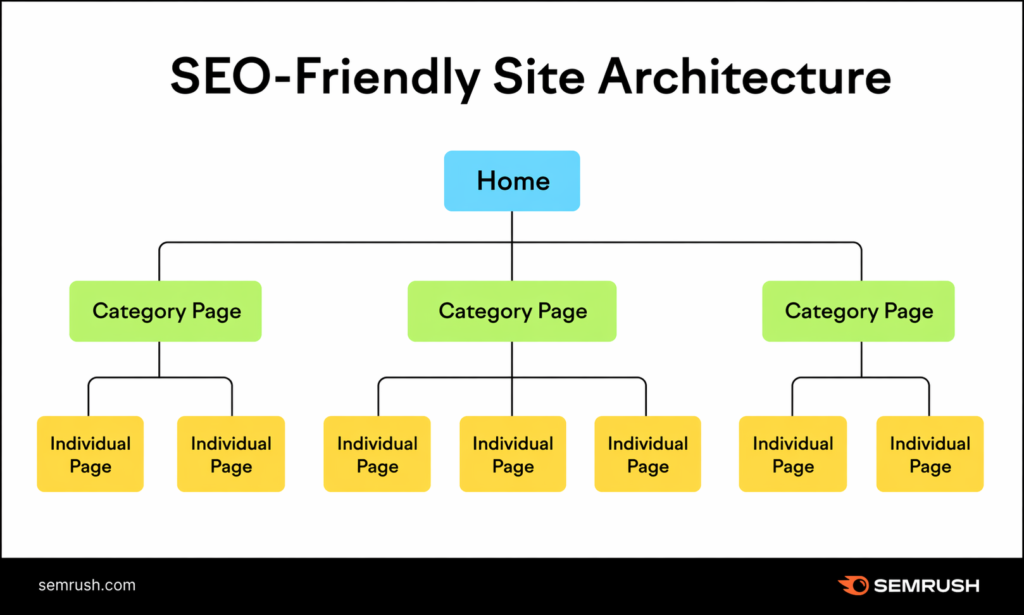
Example of a clear, SEO-friendly site architecture (source: Semrush)
A structure like this doesn’t just support rankings, it improves how users navigate and engage with your site.
Content Strategy That Aligns with Real Search Intent
Content is where SEO begins to connect with actual user behaviour.
A strong strategy is not built around publishing volume, but around understanding what your audience is searching for and why. This includes recognising the difference between early-stage research queries and decision-driven searches that indicate intent to act.
When content is aligned with intent, it does more than attract traffic. It attracts the right type of attention, which is far more likely to convert into meaningful engagement.
This is explored further in our breakdown of intent-driven SEO and why traffic alone doesn’t guarantee results.
Authority Signals That Influence Trust and Rankings
Search performance is not determined by your website alone.
Search engines evaluate how your business is positioned across the broader digital landscape. This includes backlinks from reputable sources, brand mentions, and overall online credibility.
These signals help establish trust, both with search engines and with users.
This has become even more important as search evolves beyond traditional search engine results.
AI-powered search experiences, including Google’s AI Overviews and tools such as ChatGPT, Perplexity, and Claude, increasingly rely on authority signals, structured content, and evidence of expertise when surfacing information. Visibility is no longer determined solely by where a page ranks. It is also influenced by how well a business demonstrates credibility and whether its content can be easily understood, referenced, and cited by AI systems.
In this environment, authority is no longer just an SEO consideration. It has become a broader digital trust signal that influences how both people and AI platforms discover and evaluate information.
In practice, this means that two websites with similar content can perform very differently depending on how authoritative they appear externally.
Authority building is a long-term effort, but it is often what separates average SEO performance from sustained growth.
Reporting That Should Drive Decisions, Not Just Visibility
Most businesses receive regular SEO reports, but not all reporting adds value.
Metrics such as rankings, impressions, and traffic are useful indicators, but they do not always explain performance in a way that supports decision-making. Without context, they can create a false sense of progress.
Effective SEO reporting connects activity to outcomes. It provides clarity on what is working, what needs to change, and where effort should be focused. This is where SEO starts to connect more directly with broader measurement frameworks, such as those discussed in our guide to revenue operations metrics, where visibility is tied more directly to business performance.
This becomes even more important when you consider that data-driven organisations are far more confident in their decision-making, yet many businesses are still operating without that level of clarity.
This table clearly shows what most businesses think they’re paying for, and what the real value of SEO should be.
What You Think You’re Paying For | What SEO Actually Is |
KPIs (rankings, traffic, reports) | Technical foundation for visibility |
More traffic | Content aligned to search intent |
Blog content | Authority and trust signals |
Monthly reporting | Continuous optimisation |
“SEO output” | Insight that informs decisions |
SEO is not a single deliverable. It’s a system that builds over time.
Why This Matters More Than Most Businesses Realise
Understanding what SEO includes is one thing. Understanding what it should deliver is another.
When these elements aren’t aligned to real search behaviour and business context, the impact isn’t always immediately obvious. Activity continues, reports show progress, and visibility may even improve.
But over time, the underlying issue becomes clearer.
Traffic increases, but the audience is not aligned with your offering. Content ranks, but doesn’t resonate with decision-making intent. Visibility grows, but it doesn’t translate into meaningful engagement.
This is where SEO starts to lose its value.
Not because the work isn’t being done, but because it’s not connected to the right type of attention. And in practice, that is where most SEO investments underperform, not in execution, but in alignment.
Where SEO Services Often Lose Their Value
SEO strategies rarely fail because nothing is being done.
More often, they lose effectiveness over time due to misalignment.
In many cases, there is consistent activity. Content is produced, keywords are targeted, and reports are delivered. However, without a clear connection to business goals, that activity does not translate into meaningful progress. This gap between activity and clarity is not uncommon. This becomes even more relevant when you look at how businesses are investing in marketing. While more than half of organisations are increasing their budgets, many still lack clear visibility into what is actually driving performance.
Another common issue is the disconnect between traffic and audience relevance. It is possible to attract large volumes of visitors who are not in a position to engage commercially. This creates a scenario where performance metrics look strong, but the quality of the traffic remains unchanged.
There is also an over-reliance on visibility-based metrics. Rankings and traffic can improve without necessarily contributing to revenue, particularly when intent and conversion pathways are not considered.
The gap between what SEO looks like on paper and how it performs in reality can be subtle. The table below highlights how that difference typically shows up.
What SEO Looks Like on Paper | What It Means in Practice | Actual Impact |
Increasing traffic | More visitors, mixed intent | Low engagement quality |
Higher keyword rankings | Visibility for selected terms | May not reflect buyer intent |
Regular content output | Ongoing publishing activity | Limited relevance to decision-stage users |
Monthly reports | Performance tracking | Limited clarity on real impact |
Technical optimisation | Improved site health | Only valuable when paired with intent |
The difference between visibility and relevance is where most SEO value is either realised or lost.
What This Looks Like When Strategy and Intent Align
A practical example of this can be seen in our work with a B2B SaaS business.
The company had already invested in SEO and was seeing steady traffic growth. However, this growth was not consistently translating into qualified opportunities.
Rather than increasing output, the focus shifted toward alignment.
Content was refined to better match commercial intent, key pages were restructured to support clearer user journeys, and the strategy was adjusted to prioritise decision-stage visibility.
As a result, SEO performance began to reflect not just traffic growth, but improved contribution to meaningful engagement.
You can explore the full case study here: Scaling Organic Reach in B2B SaaS
How to Evaluate an SEO Company in South Africa
Choosing the right SEO company South Africa businesses can rely on requires more than assessing technical capability. It requires understanding how that company approaches strategy.
When evaluating an SEO partner, there are a few practical indicators to look for:
- Do they focus on your business goals, not just rankings?
- Can they explain how their work connects to real user behaviour?
- Do they challenge assumptions, or simply execute requests?
- Are they transparent about trade-offs and limitations?
These are often more telling than any proposal or performance report.
A strong SEO partner will not focus only on rankings. Instead, they will seek to understand your business model, your audience, and how search fits into your broader growth objectives.
They will be able to explain how their work connects to outcomes, not just activity. They will also be transparent about what is working, what is not, and where adjustments are needed. Ultimately, the value of an SEO partner lies in their ability to connect execution with impact.
SEO Is an Investment in Long-Term Visibility, Not Immediate Results
One of the most important shifts businesses make with SEO is understanding its time horizon. SEO doesn’t operate on immediate returns. Instead, it builds over time, with each improvement contributing to future performance.
This makes it fundamentally different from short-term marketing tactics.
The work done today can continue to generate visibility, traffic, and opportunity well into the future. This compounding effect is what gives SEO its long-term value, but it also means that results depend heavily on the quality of the underlying strategy.
The Shift from SEO Delivery to Strategic Guidance
The role of an SEO company today extends far beyond implementation.
While execution remains important, most businesses aren’t looking for isolated deliverables. They need guidance on where to focus, what to prioritise, and how SEO fits into their broader marketing and growth strategy.
This is where the shift becomes clear. The expectation isn’t just delivery, but a clear direction. In practice, this means working with a partner who can connect search visibility to real business context, challenge assumptions, and guide decisions based on how users actually search and engage.
For organisations evaluating this shift, understanding how an SEO company in South Africa fits into a wider marketing and growth strategy is an important step.
What You’re Really Paying For
At its core, SEO isn’t about rankings or traffic alone. It’s about whether your business is visible in the moments that matter, when someone is actively searching for what you offer and evaluating their options.
When that alignment exists, SEO becomes a consistent and reliable driver of growth.
When it doesn’t, it creates visibility without meaningful impact.
And that is where most businesses question whether their SEO investment is actually working.