

If your SEO reports look strong, but your pipeline doesn’t, you’re not alone.
Rankings are improving. Traffic is up. Maybe you’ve been seeing steady growth month-on-month. But when you look at actual sales or qualified leads, something doesn’t add up. SEO is not a traffic channel. It’s an intent channel.
This is where most businesses get stuck.
SEO looks like it’s working, but it’s not translating into revenue. The problem isn’t SEO itself. In fact, “when it’s done right, SEO can be one of the strongest drivers of sales in a business.” Says our CEO, Mike Saunders. The issue is how it’s used within a broader ecosystem.
Visibility is Not the Same as Commercial Impact
We measure SEO performance through rankings, impressions and traffic. These metrics are easy to track and widely reported, which makes them attractive indicators of organic growth and success.
But they don’t tell the full story.
A business can rank well and still struggle to generate a pipeline. It can attract traffic and still fail to convert visitors into meaningful opportunities. This happens when visibility isn’t aligned with search intent, highlighting why not all traffic is equal.
Some users are actively looking for solutions. Others are researching, browsing, or passively engaging with content that has little commercial intent. When SEO strategies prioritise volume over intent, they drive the wrong kind of visibility. And we see this often, traffic starts to increase, but the opportunity stays stagnant.
What this means in practice is simple: you’re investing in visibility but not seeing a return in pipeline or sales. Over time, that gap becomes harder to justify.
In our experience, this is one of the most common patterns in underperforming SEO strategies: traffic grows steadily, while conversion rates remain flat or decline.
Case Study: High Rankings. Growing Traffic. Flat Revenue.
A financial services client approached us with strong SEO metrics.
Rankings were up. Traffic was climbing month after month.
But revenue wasn’t moving. Inside the CRM, it became clear why. Most of the traffic wasn’t coming from buyers.
It was coming from people early in their journey — researching, comparing, learning. The content was visible, but it wasn’t aligned to commercial intent.
The business had fallen into a common SEO trap: optimising for visibility instead of relevance.
We shifted the strategy. Instead of chasing volume, we focused on intent:
– Targeting decision-stage searches
– Building service-led pages
– Structuring content to move users toward action
The result wasn’t a spike in traffic.
It was a shift in quality.
Fewer visitors. Better opportunities.
And a clear increase in sales contribution from SEO.
This is where most businesses get it wrong.
SEO works.
But only when it’s aligned to buyers, not just search.
The Gap Between SEO Execution and Revenue
Most SEO strategies are built around execution: target keywords, produce content, improve technical performance, and acquire backlinks.
On paper, this looks like a solid SEO strategy. But execution alone doesn’t create commercial impact. The gap appears when these activities are disconnected from the outcome.
Keywords are targeted without clear commercial intent. Content is created without a defined role in the buying journey. Pages rank but don’t guide action. Traffic arrives but doesn’t progress.
Individually, these issues are easy to miss, but together, they create a system where SEO appears to be working, while revenue quietly stalls.
This is where things get expensive: reports continue to show growth, but the pipeline doesn’t move in the same direction. Sales teams see little impact, and marketing struggles to explain the gap.
SEO isn’t the problem; how it’s being applied is.
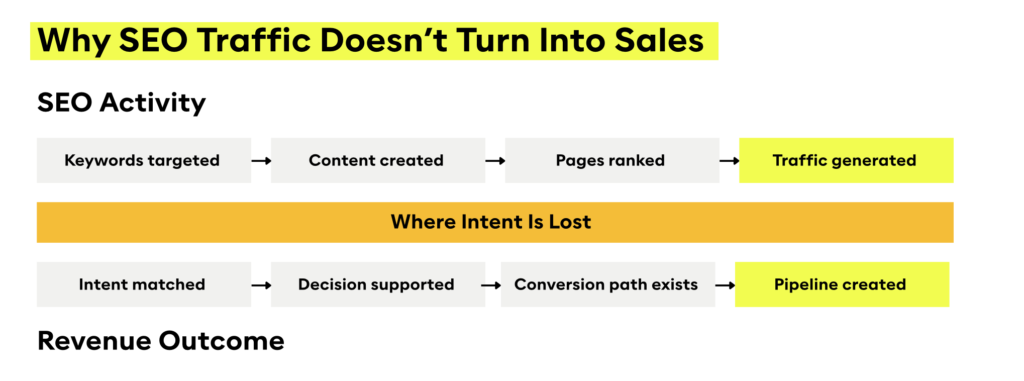
What happens after that gap is where most of the commercial impact is either recovered or lost. How leads are handled, qualified and moved through the system plays a critical role – something we unpack in more detail in this guide to revenue operations metrics.
When Traffic Doesn’t Translate into Opportunity
Not all visibility is valuable. A page can rank well, attract decent traffic, and still have no commercial impact. That doesn’t mean the SEO isn’t performing, but the attention it’s capturing isn’t aligned to decision-making or intent.
What this means in practice is simple: you can be investing in SEO, seeing steady growth, and still not be any closer to your revenue goals. That’s where the frustration comes from. It’s also where teams start questioning whether SEO is actually working, even when the reports say it is.
Someone searching “what is…” behaves very differently from someone searching “best solution for…”. Both may land on your site. But only one is likely to convert – the one whose intent is matched.
When SEO strategies don’t account for that difference, they optimise for reach instead of relevance to intent. That’s where things start to feel off, even if the numbers look good.
Search Intent Determines Commercial Value
Not all search intent carries the same commercial weight.
In practice, we often see SEO strategies leaning heavily toward informational queries because they are easier to rank for and drive higher traffic volumes. But that visibility rarely translates into pipeline.
Commercial intent behaves differently. Search volumes may be significantly lower, but the likelihood of conversion is higher because the user is closer to making a decision.
This is where many SEO strategies lose alignment.
They optimise for reach instead of relevance, capturing attention without capturing intent. And while that drives “positive” performance in reports, it doesn’t move the pipeline in the same way.
Search Type | Intent Level | Conversion Likelihood |
Informational | Low | Low |
Comparative | Medium | Medium |
Commercial | High | High |
The difference between noise and real commercial value comes down to intent.
What a Business-Focused SEO Strategy Actually Looks Like
A business-focused SEO approach doesn’t start with keywords. It starts with outcomes. Instead of asking “what can we rank for?”, it asks “what drives revenue?”
From there, the strategy focuses on aligning content with real buying behaviour.
This includes:
- Targeting queries that reflect real buying behaviour
- Mapping content to different stages of the decision process
- Aligning pages with clear conversion pathways
- Structuring content to move users toward action
This approach doesn’t ignore informational content. It uses it strategically, supporting the broader journey while maintaining a clear connection to commercial outcomes.
The goal is not just to attract traffic, but to attract the right kind of traffic and convert it.
SEO as Part of a System, not a Channel
SEO is often treated as a standalone channel. But while organic may be used as a channel, it’s actually part of an entire ecosystem. It shapes how your business is discovered, understood, and trusted before conversion even begins.
Search is often the first touchpoint, where potential customers form their initial impression of your expertise, your credibility, and your relevance to their problem.
That means SEO isn’t just about attracting traffic. It’s about showing up with the right message, at the right time, in a way that builds confidence. When SEO is aligned with real customer intent, it becomes the foundation for how your brand is perceived across the entire buying journey.
The Role of Conversion in SEO Performance
One of the most overlooked aspects of SEO is what happens after someone lands on your site.
Pages are optimised for search engines and AI retrieval, but not for the actual user. Content ranks but doesn’t clearly guide action. Calls-to-action are unclear, misplaced, or missing entirely. This is what creates a disconnect between visibility and engagement. Good SEO doesn’t just answer questions – it moves people closer to making a decision.
A user may find your page, consume the content (or even interact with it to some degree), and leave without taking the next step. Not because they aren’t interested, but because the pathway forward isn’t clearly defined.
Conversion isn’t separate from SEO. It’s part of how SEO delivers real business value beyond organic traffic.
The SEO Company You Choose Determines the Outcome
Most SEO companies focus on getting you found. The better ones focus on what that visibility does for your business.
That difference is where the outcome is determined.
An SEO company that prioritises activity will report on visibility metrics. Rankings, impressions and traffic will improve, but the connection to revenue may stay unclear.
A business-focused SEO approach goes further than rankings. It aims to connect search behaviour to real customer needs and builds content that reflect how decisions are made – extending beyond your website.
Content gets shared, insights are referenced, and your brand starts to appear consistently across search, social, and digital touchpoints. That’s where SEO starts building more than visibility. It builds trust by asking:
- Who is this traffic actually for?
- What stage of the decision process does this reflect?
- What should happen after the click?
Because when those answers are unclear, performance stops at visibility. This is where the role of an SEO company shifts from execution partner to strategic advisor.
For businesses evaluating this approach, understanding how SEO fits into a broader growth system is how strategies go from tracking rankings to delivering commercial growth organically.
Why SEO Alone Doesn’t Create Growth
SEO can be a powerful driver of growth. But it doesn’t work in isolation from the rest of your marketing.
If the content doesn’t reflect real customer needs, the right audience won’t be reached. If your messaging isn’t consistent across channels, trust doesn’t build. If your insights don’t extend beyond your website, your visibility remains limited.
This is why strong SEO strategies should closely connect content, brand, and distribution. Search may bring someone to your site, but what they find (and where else they see your brand) shapes whether they take the next step.
SEO Creates Visibility, Systems Create Revenue
SEO isn’t broken, but the way it’s often approached is.
When it’s treated as a traffic channel, it produces visibility that doesn’t always translate into results. When treated as an intent-driven strategy, it becomes something far more valuable.
It helps your business show up in the moments that matter and build credibility before conversations start. It creates a consistent presence across the channels where your audience already is. That’s where SEO shifts from activity to impact: turning attention into trust and trust into action – not just bringing people to your site.