
Traffic creates the opportunity, and your website determines what happens next. This is where many businesses become frustrated with their digital performance. Traffic looks like it’s improving, the campaigns are active, and visibility appears healthy on the surface. Yet conversions are inconsistent, leads feel weaker than expected, and the website itself never seems to perform commercially in the way it’s supposed to.
In many cases, the problem isn’t traffic. It’s friction.
Modern websites aren’t passive digital business brochures sitting online to “look professional.” They are part of decision-making environments where users evaluate trust, credibility, clarity, and confidence in seconds. Small moments of hesitation, confusion, or uncertainty quietly shape whether someone takes action or opts out.
This is one of the biggest shifts happening across website development in South Africa. Performance isn’t determined by a site’s aesthetics alone. It depends on how effectively websites reduce friction, reinforce trust, and guide users toward confident decisions.
Many websites still focus heavily on attracting attention. Far fewer are designed to convert it.
Traffic Creates Attention, but Websites Create Decisions
One of the biggest misconceptions in digital marketing is assuming traffic automatically translates into commercial momentum. It doesn’t.
Traffic simply creates the possibility of engagement. Your website itself is what determines whether that attention develops into trust, action, or conversion. This is where many businesses quietly lose performance without even realising it.
Many businesses assume visitors are carefully reading their website.
Most visitors are deciding whether they trust the business, and by the time someone starts reading your service pages, they’ve often already formed an opinion about the business itself.
Before reading deeply, users are already assessing credibility signals:
- Does this business feel trustworthy?
- Is the offering clear?
- Does the experience feel modern and reliable?
- Are the next steps obvious?
These decisions happen quickly and often subconsciously. A website may attract thousands of monthly visitors while still underperforming commercially because uncertainty interrupts the decision-making process before users reach a conversion point.
Most Users Decide Faster Than Businesses Realise
Modern browsing behaviour is heavily shaped by speed, clarity, and cognitive effort. Users don’t move through websites patiently trying to “figure things out.” They scan, compare, and evaluate quickly. If the experience feels unclear, cluttered, slow, or disconnected, hesitation immediately takes over the experience.
This is one of the reasons strong website performance depends heavily on clarity. Navigation needs to feel intuitive. Messaging needs to quickly establish relevance. Service pages should guide understanding naturally instead of overwhelming users with unnecessary information or generic corporate language.
The best-performing websites reduce the amount of work users need to do mentally.
That shift matters because hesitation compounds quietly online. Just a slightly confusing navigation structure, unclear positioning, weak calls-to-action, or inconsistent messaging may seem small individually. Together, they create enough friction for users to leave without wanting to taking action.
The Trust Problem Hidden Inside Modern Website Design
One of the biggest problems in modern website design is how similar many websites have become.
Across industries, businesses often rely on the same layouts, messaging patterns, stock imagery, and generic positioning statements. Visually, the website may appear polished, but strategically, it’s difficult for users to understand what genuinely differentiates the business from dozens of competitors offering similar services.
This creates a tangible trust problem. When websites feel interchangeable, users struggle to confidently know what makes the business uniquely credible or valuable. The experience becomes forgettable rather than persuasive. It’s an increasingly common theme we see across website design in South Africa – where many websites still prioritise aesthetics over strategic communication, usability, and conversion flow.
Good design does matter. Strong visual presentation absolutely influences trust perception, but websites built purely around appearance often underperform because they don’t clearly guide users toward meaningful decisions.
A Good-Looking Website Can Still Create Friction
A visually impressive website can still perform poorly commercially. This usually happens when the design decisions prioritise appearance without considering the site’s usability, behaviour, or conversion psychology. Large banners push important information below the fold, and navigation becomes overly minimalistic. Messaging stays vague in an attempt to sound sophisticated, while the calls-to-action become secondary to the visual presentation. The result is a modern-looking website that quietly weakens decision-making clarity.
High-performing websites behave differently.
They create visual simplicity while strengthening strategic clarity. Information is structured intentionally, helping users understand where to focus, and the pages guide attention naturally instead of competing for it. This is where design stops being decorative and becomes functional.
Uncertainty Is More Expensive Than You Think
Most users leave a website because uncertainty builds during their experience – not because they subconsciously decided it’s not worth their time.
The offering may feel vague, or the value proposition may be unclear. The process could seem confusing, making the next step feel less obvious. Individually, these moments seem small, but they create hesitation strong enough to interrupt commercial action.
This is one of the most overlooked aspects of modern website performance. A high-converting website reduces uncertainty continuously throughout the user journey. It answers questions before users need to ask them, and reinforces credibility consistently. It simplifies decisions rather than complicates them.
Trust isn’t built through a single moment online. It’s reinforced gradually through consistency.
Most Websites Explain Services Without Building Confidence
Many websites focus heavily on describing services while doing very little to strengthen confidence around them. Users don’t just want information. They want reassurance. This is where messaging your strategy becomes important.
Strong website content helps users feel more informed, certain, and confident about taking the next step. Weak content often repeats generic claims without demonstrating practical understanding or relevance.
This is also why E-E-A-T principles are becoming increasingly important within the modern website experience. These are the signals that shape how users evaluate credibility online long before any conversion happens.
The Technical Problems Users Feel Before They Notice
Technical performance issues aren’t dramatic breakdowns. Most of the time, the user never consciously identifies what went wrong. They simply leave the site feeling slightly frustrated, unconvinced, or mentally fatigued without fully understanding why.
Think about how people actually browse websites today:
Someone searches for a service on their phone during a lunch break or between meetings. They open a website expecting quick clarity. Instead, the page takes slightly too long to load, and a huge pop-up appears before they’ve even read the headline. The text shifts while loading and they accidentally tap the wrong button. Navigation feels cluttered. The contact form looks unnecessarily long. Halfway through scrolling, they lose patience and leave to compare another provider instead.
Nothing technically “broke”. The website is still online. The pages still loaded.
The forms still worked. The experience, however, quietly created enough friction to interrupt trust and decision-making. This is what makes technical website performance far more important commercially than many businesses realise. Users experience the technical issues emotionally before businesses diagnose them operationally.
A website doesn’t need to crash completely to weaken conversions. Small friction points are often enough.
How Speed, Stability, and Mobile Experience Affect Trust
Website performance directly shapes the user’s confidence. A slow-loading website creates hesitation before users even have a chance to engage with your content. Poor mobile responsiveness creates frustration during navigation. Weak hosting environments introduce instability that quietly undermines trust and engagement.
This is where your site’s infrastructure is a strategic consideration. Strong WordPress hosting affects far more than just your site’s uptime. It influences loading speed, accessibility, security, and the overall reliability of the user experience.
The same applies to secure website hosting. Security signals increasingly influence both search visibility and user trust, particularly now that users are more aware of privacy, safety, and site legitimacy online.
How Technical Friction Quietly Affects Website Performance
Friction Point | User Experience Impact | Commercial Impact |
Slow page speed | Frustration and drop-offs | Lower conversion rates |
Poor mobile usability | Harder navigation and readability | Reduced engagement |
Weak hosting stability | Inconsistent performance | Lower trust perception |
Broken forms or CTAs | Interrupted journeys | Lost enquiries and leads |
Confusing site structure | Higher cognitive effort | Increased abandonment |
Technical performance doesn’t only affect functionality, it shapes how trustworthy the entire business experience feels online.
Interest Is Lost Long Before Users Reach the Contact Page
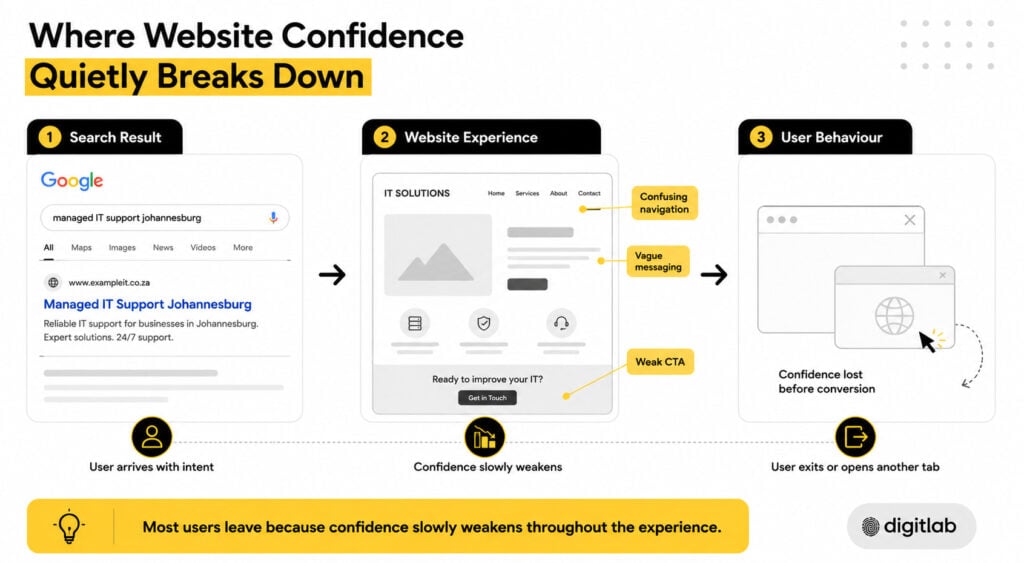
Many websites lose potential customers long before users ever reach a contact form, pricing page, or enquiry button. The interest initially existed – that’s why the user clicked in the first place. What changes is the level of confidence the experience creates afterwards.
Imagine a small business owner searching for “managed IT support for small businesses in Johannesburg” after dealing with recurring downtime issues internally. They are actively looking for reassurance, clarity, and confidence that someone understands the operational pressure they are under.
They open a website expecting quick answers. Instead, the homepage leads with vague corporate messaging about “innovative technology solutions.” The navigation feels cluttered, and some buttons lead to the same page. Service pages are filled with technical jargon but don’t clearly explain what problems are actually solved, how support works, or why this provider is different from the next five tabs already open in the browser. At some point, this small business owner stops progressing in the search and user journey. Not because they consciously reject the business, but because the experience slowly weakens certainty faster than it builds trust.
This is where many high-traffic websites underperform commercially. Traffic arrives through search, advertising, referrals, or social channels, but the website itself lacks the structure needed to maintain confidence throughout the journey. Calls-to-action technically exist but appear before enough trust has been established. Important information is buried beneath clutter, generic messaging, or poor prioritisation.
The issue is rarely an absence of effort. The website just lacks intentional conversion architecture designed around how users actually evaluate decisions online.
Visibility Means Very Little Without Direction
A website should guide users, not just attract them. This is where we see many websites underperform in the market. Users land on pages successfully, though the experience itself does very little to create progression. There’s no clear journey, no reinforcement of confidence, and no intentional movement toward the next stage of decision-making.
Strong websites create directional momentum.
Every page should help users understand where they are, why it matters, and what they should reasonably do next. Without that structure, traffic becomes passive visibility instead of meaningful engagement.
Visibility Means Very Little If the Website Doesn’t Build Confidence
SEO and website experiences can’t function as separate strategies anymore. They never should have in the first place. Search engines evaluate how users engage with websites after arriving. Poor engagement signals, weak usability, slow performance, and fragmented user journeys all influence your site’s visibility over time because they shape the overall experience quality.
A user may discover your business through Google, click through with genuine interest, and still leave unconvinced within seconds because the experience itself creates uncertainty. The messaging feels generic, navigation is difficult, or the website looks outdated compared to competitors. The traffic itself was never the problem. The experience simply couldn’t maintain confidence after the click.
This is one of the biggest shifts shaping modern website development in South Africa. Websites now need to support the entire decision-making process by balancing discoverability, usability, technical performance, trust, and conversion flow simultaneously.
We see this particularly clearly in hospitality and experience-driven industries where digital perception shapes trust before a customer ever makes contact. In our work with Manzi Monate, the website experience needed to do far more than present information. It needed to reinforce the feeling of the destination itself through clearer journeys, stronger visual confidence, and a more intuitive user experience that aligned with user expectations before enquiry decisions were made.
Modern websites aren’t just digital touchpoints. They shape how credibility is experienced online.
The Best Websites Make Decisions Feel Easier
High-performing websites succeed because they reduce the mental effort required for users to move forward confidently. This is one of the most overlooked aspects of website performance. Many businesses assume users need more explanations, more features, and more pages before they are ready to take action. Most users, though, are simply looking for clarity, reassurance, and enough confidence to continue progressing through the journey without second-guessing themselves constantly.
The strongest websites understand this intuitively. Navigation that feels natural instead of overwhelming. Messaging that answers important questions before users need to manually search for them. Calls-to-action appear at moments where trust has already been reinforced rather than prematurely demanding commitment before enough confidence exists.
This is where a strong website strategy is less about aesthetics and more about behavioural design. Think about how often users quietly hesitate during a website experience. They compare unclear service options. They search endlessly for pricing or contact information. They try to interpret vague messaging that sounds impressive but explains very little. They open multiple tabs because no single website feels convincing enough to stop searching. Most users will never consciously identify these frustrations individually. They simply leave the experience feeling less certain than when they arrived.
That is why the highest-performing websites are often the clearest rather than the most complicated. They make decisions feel easier. This also connects closely to the broader shifts explored in common “SEO mistakes” and “answer engine optimisation”, where search visibility is shaped by how clearly you communicate expertise, reduce digital friction, and create trustworthy experiences across connected digital environments.
Most Websites Don’t Have a Traffic Problem
Many businesses assume their website needs more traffic when the real issue is what happens after users arrive.
The website may already successfully attract attention. The deeper problem is that the experience itself is not reinforcing enough clarity, confidence, or direction to convert that attention meaningfully.
This is why modern website development in South Africa should be approached less like a standalone design project and more like a performance system.
Strong websites do more than look professional. They reduce uncertainty, reinforce trust, guide decisions, and they create momentum toward action. That is what separates websites that simply attract visitors from websites that contribute meaningfully to business growth.