

AI Search Creates a Trust Layer Beyond Rankings
One of the biggest misconceptions around AI search is that traditional rankings alone determine visibility within generated responses. They don’t.
AI systems evaluate whether a source appears trustworthy enough to contribute to an answer confidently. That evaluation extends beyond rankings into broader signals of authority, consistency, and contextual relevance. This creates an entirely different layer of discoverability.
A page may rank highly, though fragmented messaging, weak authority signals, or inconsistent positioning across the web can still reduce the likelihood of that brand being referenced within AI-generated search experiences.
In practice, this means discoverability is becoming less about isolated performance metrics and more about overall interpretability.
That changes how brands need to think about digital authority entirely.
AI Systems Reward Brands They Can Validate Consistently
AI search systems are designed to reduce uncertainty. To do that, they compare information across different sources, look for recurring patterns, and reinforce information that appears consistently credible across the broader digital ecosystem.
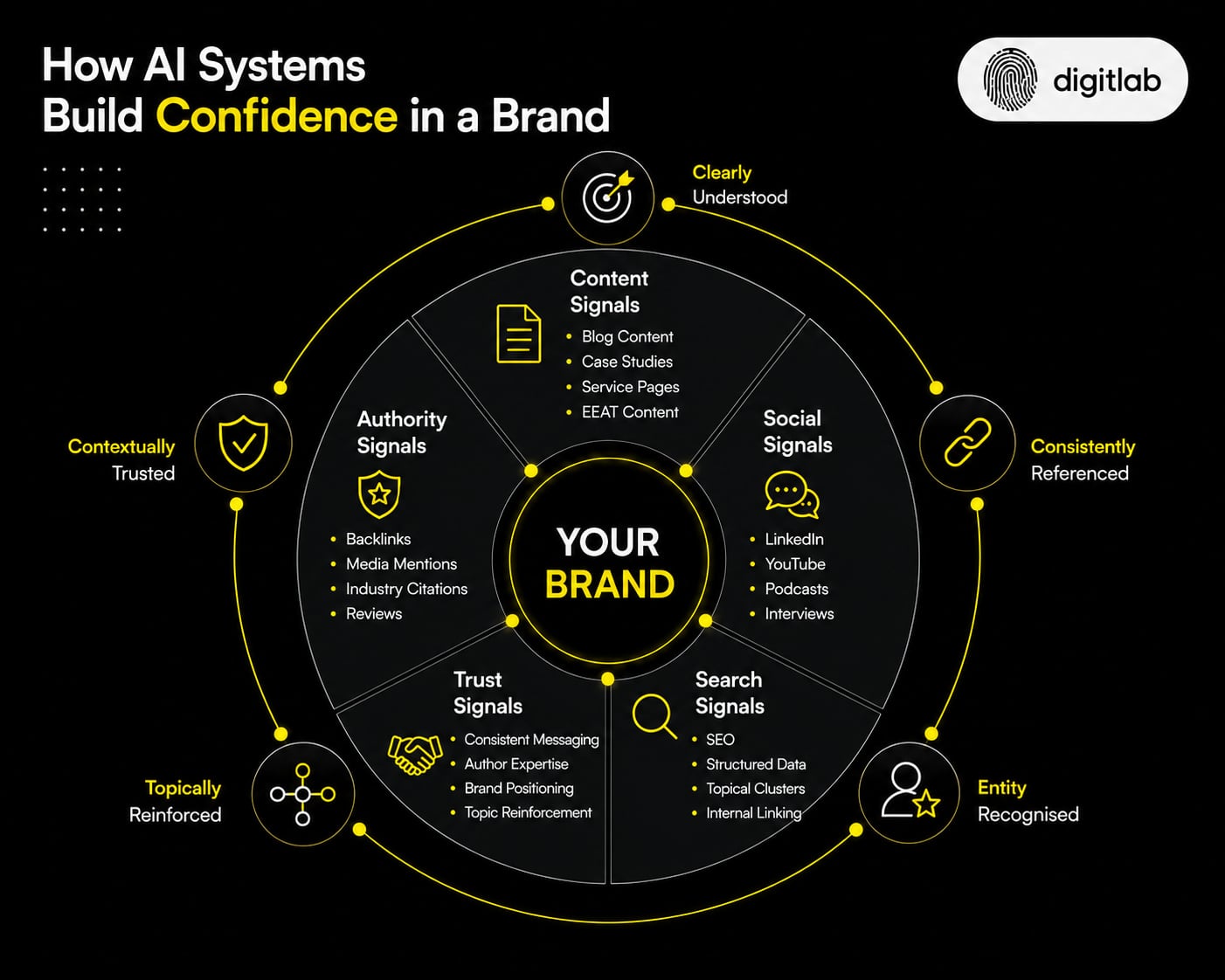
This changes how digital authority is reinforced and recognised online. A single well-optimised page is rarely enough to build strong AI visibility on its own. What matters more is whether expertise is reinforced consistently across websites and pages, citations, mentions, social discussions, industry references, and related content ecosystems.
We are already seeing this emerge in practice.
Brands with fragmented positioning often struggle to build strong AI visibility because the signals surrounding them lack consistency. A business may describe itself one way on its website, another way on LinkedIn, and differently again across third-party platforms or media mentions. For AI systems, this creates ambiguity around what the brand actually represents.
The opposite is also becoming true.
Brands that consistently reinforce expertise across multiple touchpoints become easier for AI systems to classify confidently within a topic or category. A cybersecurity company consistently publishing around governance, compliance, and risk management becomes easier to associate with enterprise security expertise. A B2B SaaS brand repeatedly referenced in conversations around workflow automation or CRM implementation strengthens its contextual authority over time.
This is one of the biggest shifts generative engine optimisation introduces. AI visibility depends on whether your authority can be validated contextually across the web.
GEO Depends on Content That AI Can Clearly Interpret
In traditional SEO, content was often designed primarily for rankings and engagement. GEO introduces a different requirement: interpretability.
AI systems need to understand not just what a page is saying, but what expertise it represents, how it connects to related topics, and whether it aligns consistently with broader authority signals. This places far greater emphasis on semantic clarity.
Content needs to communicate expertise in a way that is structured, contextual, and reinforced across related subject areas. Pages that lack focus, topical depth, or contextual alignment become harder for AI systems to classify confidently.
This is also where experience, expertise, authority, and trust become increasingly relevant within AI-driven search. These aren’t abstract SEO concepts. They are becoming part of how AI systems determine which brands appear credible enough to surface time and time again.
This is why content strategy is shifting away from isolated articles and toward connected authority ecosystems.
AI Visibility is Built Across Entire Digital Ecosystems
One of the most misunderstood aspects of generative engine optimisation is where these AI systems gather confidence from. Most businesses still approach visibility as a website problem. In reality, AI systems evaluate authority across much broader digital ecosystems. Your website is only one source among many.
AI models increasingly assess whether expertise is consistent and reinforced across multiple environments. That includes:
- Third-party mentions and publications
- Industry citations
- Review platforms
- Social conversations
- Reviews
- Authoritative backlinks
- Podcasts, interviews, and forums
- Related content networks
This creates a very different visibility challenge.
A brand may invest heavily in SEO while still struggling to gain strong AI visibility because its broader authority signals are fragmented or disconnected. This is where marketing systems become strategically important. When messaging, positioning, expertise, and content ecosystems align consistently across channels, AI systems gain stronger contextual confidence in what a brand represents. That consistency becomes a “discoverability advantage.”
And this is where generative engine optimisation starts looking less like SEO and more like digital authority engineering.
“AI visibility is shaped by consistency across the web not just the rankings”
South African Brands Are Earlier in This Shift Than They Realise
One of the biggest opportunities in generative engine optimisation is how early most South African businesses still are in adapting to it. Many organisations are still heavily focused on traditional SEO reporting and visibility metrics, while AI-driven discovery is already reshaping how users evaluate their credibility and shortlist providers globally.
This is a rare strategic gap.
Brands that start strengthening their authority signals, reinforcing expertise consistently, and building clearer, consistent digital ecosystems now are more likely to establish stronger AI visibility advantages long before GEO becomes standard practice locally.
This is especially important in industries where trust signals heavily influence decision-making:
- Financial services
- Legal services
- Healthcare
- B2B software
- Property
- Renewable energy
- Education
In these sectors, discoverability is increasingly shaped by whether AI systems can confidently interpret a brand as credible within a specific category – changing how authority needs to be built.
The businesses that adapt earliest aren’t likely to win simply because they publish more content. They are more likely to win because they become easier for AI systems to understand, validate, and reference consistently.
GEO Is Changing What Effective SEO Strategy Looks Like
Generative engine optimisation doesn’t replace SEO, but it does change what a strong SEO strategy needs to accomplish.
While traditional SEO performance metrics still matter, they’re not enough on their own to build strong discoverability in AI-driven environments. GEO introduces a broader strategic requirement.
Brands now need to reinforce expertise across connected topic ecosystems, strengthen contextual authority signals, and maintain consistency across the wider digital environment AI systems use to evaluate trust. This shifts SEO away from isolated ranking activity and closer toward “authority engineering.” Instead of treating pages as standalone ranking opportunities, businesses now need structured content ecosystems that reinforce expertise across related subjects, platforms, and conversations. This aligns closely with how AI is reshaping SEO, where discoverability is increasingly influenced by interpretation rather than retrieval alone.
It also changes how businesses should evaluate SEO strategy and services, because while technical optimisation still forms part of the foundation, long-term visibility depends on how clearly expertise is reinforced across digital ecosystems.
GEO Is Reshaping How Marketing Effectiveness Is Measured
Traditional reporting frameworks were never designed to properly measure the new visibility layer. A brand may influence how users understand a certain topic, compare providers, or form trust without generating a direct click or measurable interaction. That influence can still significantly shape decisions, even when attribution is unclear.
This creates a growing disconnect between visibility and measurable engagement.
Many businesses are still evaluating search performance through traffic and interaction metrics alone, while AI-driven discovery is shaping perception before users ever reach a website. That changes what marketing effectiveness starts to mean.
Visibility isn’t just driving interaction. It’s reinforcing credibility, contextual authority, and discoverability across the environments where AI systems form confidence in a brand. The businesses that understand this shift early on can build stronger long-term discoverability as AI-driven search matures.
The Future of Search Belongs to Interpretable Brands
The future of search visibility depends less on who is first to appear and more on who AI systems trust enough to interpret confidently. This changes what effective digital strategy is responsible for.
Simply creating content that ranks isn’t enough. Brands should be building authority systems that reinforce their expertise consistently enough for AI-driven environments to recognise, validate, and surface reliably. This is what generative engine optimisation introduces. A shift away from isolated visibility tactics toward interpretable digital authority.
As AI search continues evolving, the brands most likely to shape decisions won’t necessarily be the loudest or the most visible. They will be the brands AI systems understand with the least amount of uncertainty.