

Search is changing, but not in the way most businesses expect.
For years, SEO has been built around a relatively simple model: rank well, drive traffic, convert visitors. That model created a clear line between visibility and performance.
Today, that line is less defined.
AI isn’t replacing search engines, but it has changed how people interact with them. Instead of scanning results and clicking through multiple pages, users are increasingly receiving direct answers, summaries, and recommendations within the search experience itself.
This shift is already visible in how people behave. Exploration is being replaced with expectation: users want clarity immediately, not after multiple clicks. That changes the role of SEO entirely and has a direct impact on how businesses approach their digital growth strategy.
Search Has Changed, But Most Strategies Haven’t
Most SEO strategies still operate on the familiar playbook. Target keywords. Create content. Improve rankings. Track traffic.
On paper, this approach continues to show progress, with visibility improving, traffic growing, and reports suggesting forward movement – but beneath that, something doesn’t quite align. Traffic doesn’t always translate into meaningful engagement. Visibility doesn’t always result in attention. And the connection between SEO activity and business impact becomes harder to define.
This shift is also reflected in broader user behaviour. Research from Nielsen Norman Group highlights this shift clearly: users are moving away from traditional browsing behaviour and toward faster, answer-driven interactions, where the expectation is immediate clarity rather than exploration.
SEO hasn’t stopped being effective, but the environment it operates in has fundamentally changed – and that is how we entered the ‘zero click’ era.
What AI Search Actually Changes
Traditional search engines functioned as retrieval systems. A user searched for something, a list of relevant pages were generated, the user clicked on one (or a couple), explored a few more, and made decisions.
Search is now more conversational, more contextual, and increasingly summarised. Instead of presenting options, AI platforms interpret intent and deliver synthesised answers often generated from multiple sources, with only limited visibility given to the original content.
Search has moved from retrieval to interpretation – and that changes what visibility actually means.
From Rankings to Selection: A Fundamental Shift
Ranking still matters, possibly even more now, though it’s not the final outcome. In AI-driven search environments, content isn’t just ranked – it’s selected: based on topical depth, authority signals, search intent, and context.
This introduces a new layer of competition and complexity.
Multiple sources may rank for the same query, but only a handful are used to construct AI-generated responses. This means visibility isn’t evenly distributed across the results page, which leads us back to presence alone not being enough.
Your content needs to be clear, credible, and structured in a way that allows AI systems to interpret and prioritise it.
Why Visibility Doesn’t Guarantee Attention
One of the most important shifts in modern search is the growing gap between visibility and attention.
While a page may still rank well, generate impressions, and reports show positive trends, it doesn’t necessarily mean users are engaging with that content in the same way.
Users are getting what they need before they ever get to click.
AI-generated summaries, featured answers, and conversational interfaces are reducing the need to explore multiple sources. The decision-making process is being compressed into a single interaction.
This creates a scenario that many businesses are already experiencing, but struggling to explain why SEO appears to be working, but the outcome doesn’t reflect the same momentum.
This pattern closely mirrors what we explored in why SEO doesn’t always translate into revenue, where visibility improves, but meaningful engagement doesn’t follow at the same pace. The issue isn’t performance in isolation. It is how that performance translates into real attention.
How AI Is Reshaping Digital Growth Strategy
This shift has broader implications beyond SEO and is reshaping how modern growth strategies are structured.
A modern digital growth strategy can’t rely on individual channels operating independently anymore. AI-driven discovery connects content, authority, and context across multiple platforms.
Search isn’t isolated. It’s influenced by:
- Website content
- External mentions
- Brand authority
- Content consistency
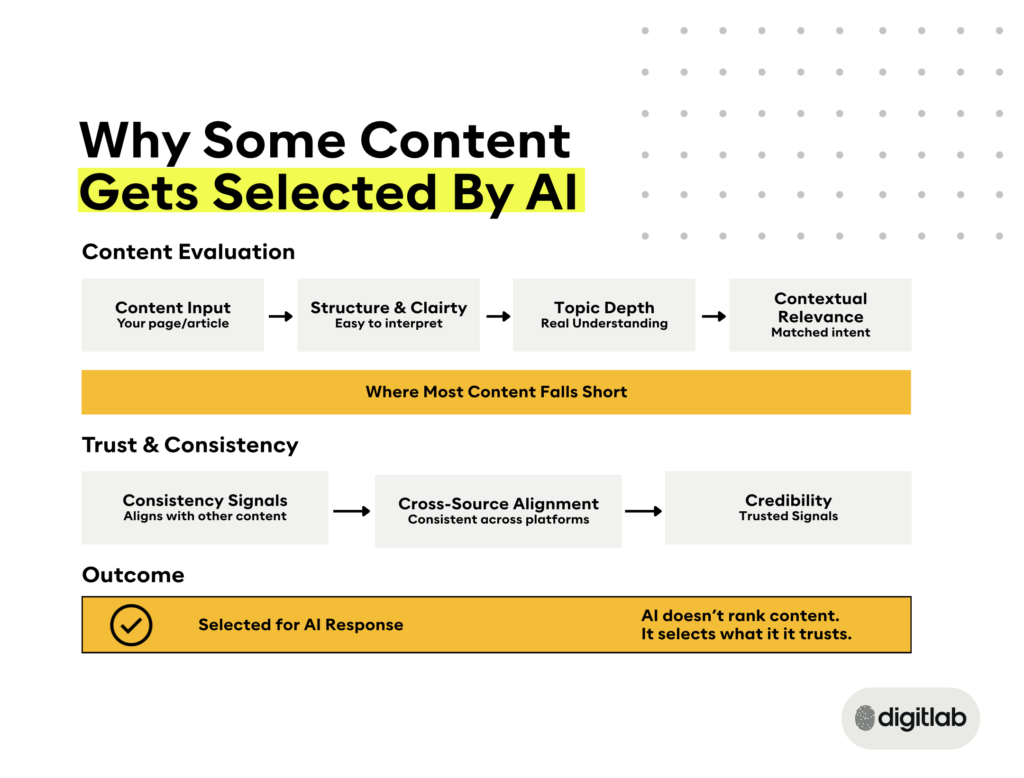
In practice, this means content that is clearly structured, logically organised, and contextually relevant tends to perform better. AI systems aren’t just scanning for keywords. They are evaluating whether a piece of content provides a coherent and reliable answer to a specific query.
We often see this play out when comparing two pieces of content targeting the same topic. One may be optimised for search engines in the traditional sense, while the other is written with clarity, depth, and structure in mind. The latter is far more likely to be selected and referenced in AI-generated responses.
This is where the shift becomes clear: content isn’t just competing for rankings – it’s competing to be understood.
The Role of Content Has Changed
Content has always been central to SEO, but its role is evolving. Previously, content was created primarily for users and search engines.
Now, it is also interpreted by AI systems, which changes how content needs to be structured and written. This is where the concept of content clunking comes into play.
If your content doesn’t have a distinct heading hierarchy, short paragraphs that focus on one core idea, and the use of bullets to break up text, it becomes significantly harder for both users and AI systems to interpret your content. Content should showcase originality, support follow-up questions, and provide practical advice – nothing new to the SEO world. What is new, though, is the added layer of how users and AI both interact with your content.
It’s not just about ranking for keywords. It is about providing clarity, context, and depth in a way that can be easily understood, extracted, and summarised. What determines whether your content is surfaced in AI-generated responses depends on how well it can be interpreted and trusted as a whole.
The process is less about optimisation in isolation, and more about how structure, depth, and relevance come together.
Why Authority Matters More Than Ever
As AI systems evaluate multiple sources, authority becomes the defining factor. This goes beyond traditional SEO signals and means that your content is measured on E-E-A-T principles more heavily.
Authority now extends beyond traditional SEO signals. It’s reflected in how consistently your brand shows up, how clearly your messaging aligns, how often your content is referenced, and how deeply you cover a topic. Authority isn’t built on a single page. It is built across an entire digital footprint.
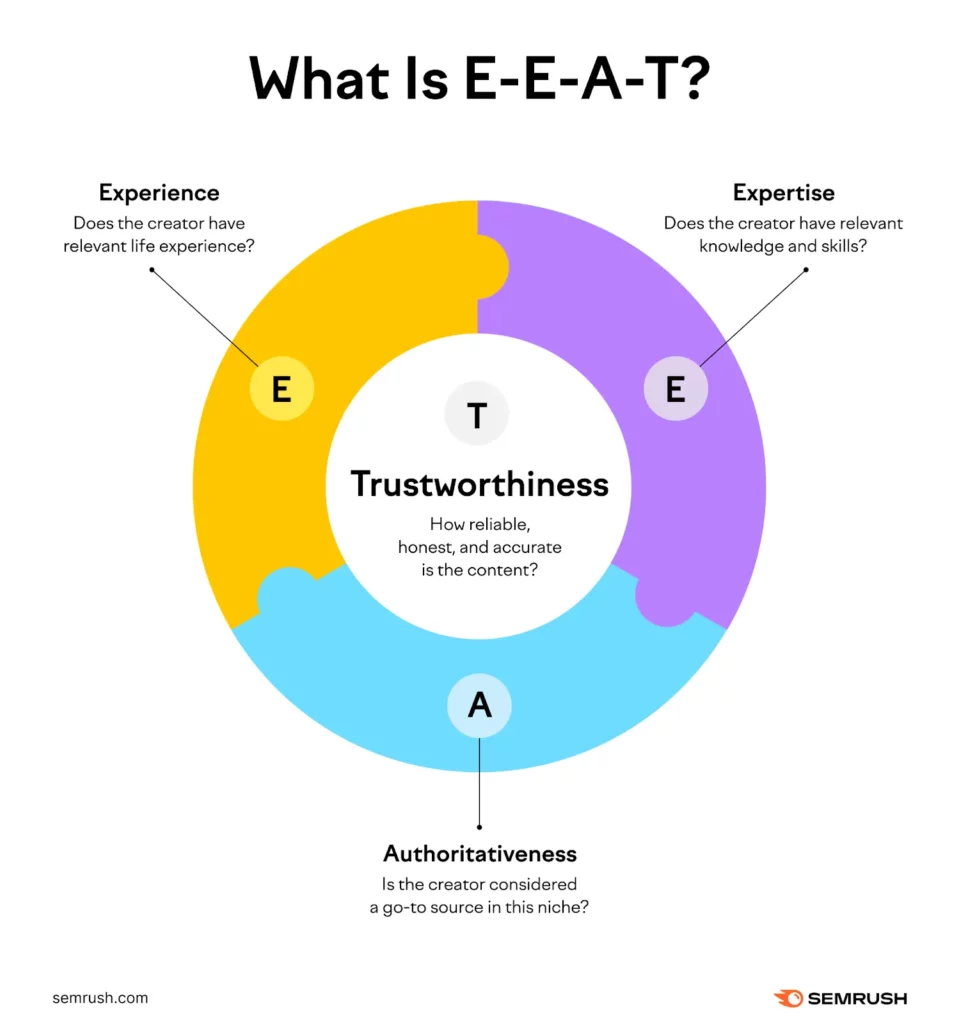
E-E-A-T Signals for Driving AI visibility (source: SEMrush)