

There’s a specific kind of sales conversation that makes marketing teams uncomfortable, and your sales team recognises it instantly.
A prospect has downloaded your latest guide, explored several service pages, completed a detailed enquiry form and explained the problem they are trying to solve. Marketing captures the information, the lead is qualified and the CRM successfully assigns it to sales.
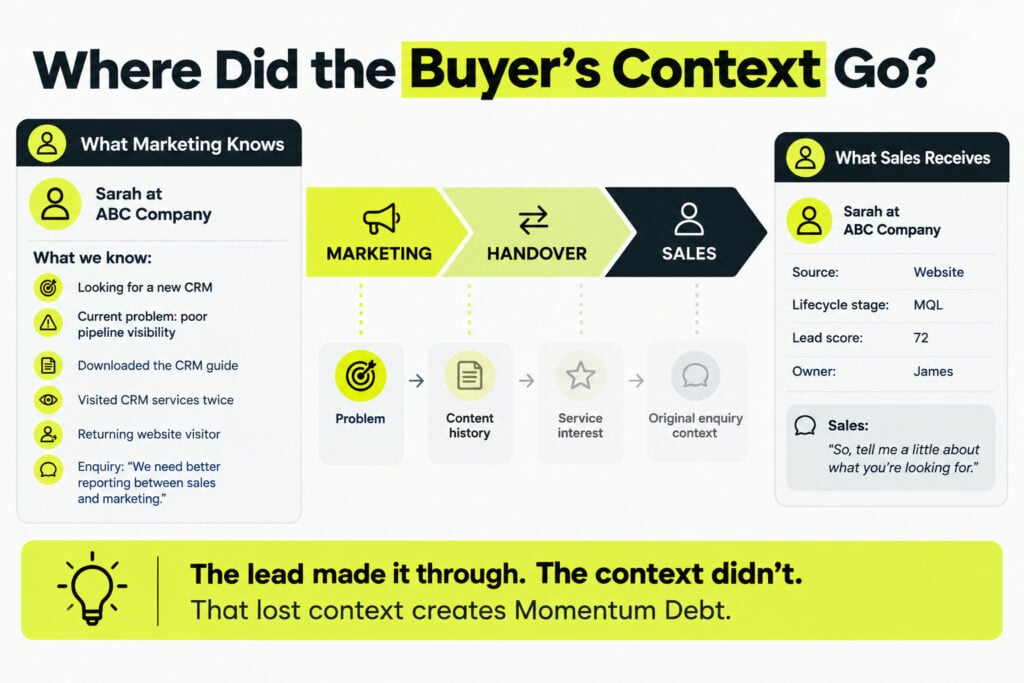
Then the first sales conversation kicks off with: “So, tell me a little about what you’re looking for.”
Although the lead was captured and assigned to the right salesperson, somewhere between marketing knowing something and sales acting on it, the customer’s context disappeared. That’s a handover problem worth paying attention to.
Inbound sales leads generally lose momentum across several small transitions as information is captured, interpreted, transferred and eventually turned into a sales conversation. Each transition creates an opportunity to preserve what the business has already learnt about the buyer, or lose some of it.
We have a term for that: Momentum Debt. It’s the friction that builds when customer context, responsibility or progress is lost as an inbound lead moves between teams, systems and stages. And unlike a missed form submission or broken CRM integration, Momentum Debt can exist while every system works perfectly.
Inbound Sales Leads Don’t Experience Your Handover
The phrase “marketing-to-sales handover” makes perfect sense internally. Marketing’s responsibility changes, sales takes ownership and the CRM records the transition. The buyer doesn’t experience any of that. They experience one business.
If they have already explained what service they need, they expect the next conversation to reflect that knowledge. If they downloaded content about a specific problem, visited the relevant service pages and submitted an enquiry, they reasonably assume that information has moved with them.
This is especially important in B2B inbound sales, where an enquiry is rarely the first interaction with the business. Buyers often arrive at the point of contact after doing substantial research independently.
GrowthPulse Media’s analysis of the cost of B2B lead generation in South Africa highlights how expensive it’s become to acquire and convert inbound interest, reinforcing the pressure on businesses to make every enquiry count. It also reinforces an important shift in behaviour: by the time buyers engage with sales, they have often already done significant research before ever speaking to a representative.
That changes the job of the handover. Sales isn’t necessarily starting a conversation from zero. It may be inheriting a conversation the customer believes has already started.
Momentum Debt starts when the business treats those as the same thing.
One Lead. Four Places for Context to Disappear
It’s tempting to look for one broken handover between marketing and sales and blame it all on that one instance. In practice, an inbound lead passes through several smaller handovers before a meaningful sales conversation ever happens.
Stage | What the business does | What buyers need | Where momentum disappears |
Capture | Records an enquiry or action | Recognition of what they asked for | Valuable context is collected but never carried forward |
Interpretation | Decides what the behaviour means | Understanding of their situation | Behaviour is reduced to a score, source or generic lead label |
Transfer | Moves the lead to the right person | The right person to receive the context | Ownership moves, but the buyer’s story doesn’t |
Continuation | Starts the sales process | The conversation to move forward | Sales restarts discovery from information the buyer already supplied |
This just shows that the final sales conversation can only be as informed as the context that survives the previous three stages.
Take qualification. A prospect may have downloaded three resources, returned to the website repeatedly and finally submitted an enquiry. Marketing sees an engaged lead. Sales sees a name, email address and lead score. The CRM sees a successfully routed record. All three versions are technically correct. Only one contains the buyer’s story.
This is where the distinction between lead nurturing and lead generation becomes useful. The activity that created and developed interest before the enquiry shouldn’t become invisible because the prospect crossed an internal lifecycle stage.
A healthy handover preserves enough of that history for the next person to understand who the lead is, and why the conversation is happening now.
Your Inbound Lead Has Already Done Some of the Talking
There is a strange habit in B2B sales where businesses spend enormous effort collecting customer information and then ask customers for it again.
The enquiry form asks about the challenge. Marketing automation records which content was downloaded. Analytics show which services attracted attention. The CRM stores the original source.
Then sales asks, “What brings you to us?”
We’re not saying there’s anything inherently wrong with that question. Good discovery requires salespeople to hear the customer’s situation in their own words rather than treating behavioural data as fact. The problem is the reset.
There is a meaningful difference between: “Tell me what you’re looking for.”
and: “I can see you’ve been looking at our CRM implementation content and mentioned that reporting between your sales and marketing teams is becoming difficult. I’d like to understand what’s happening there.”
The second conversation still invites discovery. It proves that the business was listening before the salesperson arrived.
That distinction is particularly relevant in South Africa. Stronger customer experiences increasingly depend on balancing efficient technology with human input at the moments where it matters. That is a useful way to think about the sales handover too. Technology should carry the context. People should know what to do with it.
A Successful Transfer Isn’t the Same as a Successful Handover
This is where dashboards can become surprisingly reassuring.
- Lead assigned: successful.
- Sales notification: sent.
- Lifecycle stage: updated.
- Follow-up task: created.
From a systems perspective, the handover is complete. From the buyer’s perspective, nothing meaningful has happened yet.
The real test starts when the next person interacts with them.
Did sales receive the reason for the enquiry, or only the contact details? Can they see which content or services influenced the prospect? Does the salesperson understand what marketing has already communicated? If the buyer spoke to somebody previously, is that conversation visible?
This is why CRM software can enable an excellent handover without being able to define one. The system can preserve fields, trigger tasks, route enquiries and create visibility, but the business still has to decide which context matters enough to travel with the lead.
The same applies to lead generation and marketing automation. Automation can make transfers faster and more consistent. It can’t decide whether the recipient has everything required to continue the conversation.
A handover isn’t complete when ownership changes in the CRM. It’s complete when the next person can pick up the conversation without making the customer rebuild it.
The Cost of Starting the Conversation Twice
Having to repeat yourself is irritating, that is deeply relatable. In a B2B buying journey, however, the commercial problem goes deeper than inconvenience.
Marketing spent time creating familiarity before the enquiry. Content has answered questions. The website has established relevance. Case studies may have reduced perceived risk. The prospect has gradually gathered enough confidence to identify themselves and start a conversation.
A poor handover spends some of that confidence immediately.
Let’s say you’re a looking for a new CRM, and explain on an enquiry form that your current system can’t provide reliable pipeline reporting. When you get a sales call, you receive a generic product introduction followed by basic qualification questions that ignore what you’ve already shared.
The salesperson hasn’t necessarily done anything wrong. They may have received a record that stripped the enquiry down to its administrative essentials.
But you, as the customer, now have to do extra work by repeating the problem, restore the context and bring the supplier back to the point you believed the relationship already reached.
That is Momentum Debt in practice.
It doesn’t necessarily kill the opportunity. It asks the customer to spend effort recovering progress the business already earned.
For inbound leads, that’s an expensive habit because the advantage of inbound is precisely that the buyer arrives with some degree of self-generated momentum. The handover should preserve it.
Run One Inbound Lead Through the Handover Test
You don’t need a new dashboard to find Momentum Debt. Pick one genuine inbound enquiry from the last month and trace it from the first identifiable conversion to the first meaningful sales conversation.
Then answer four questions:
- What did we know when they converted?
Look beyond contact details and to what the enquiry, content history, source and previous interactions tell you. - What did we decide that information meant?
Look at how the lead was qualified or interpreted, and what evidence supported that interpretation. - What information actually reached sales?
Consider what the salesperson can realistically see and use when preparing for the conversation. - What did the customer have to tell us again?
This is the revealing one. Anything the buyer had already communicated but needed to reconstruct during the sales conversation represents context that failed to survive the journey.
Do this with five or ten enquiries and patterns will start to emerge.
Perhaps forms collect unnecessary information. Maybe marketing knows more about an enquiry than sales can see. Perhaps sales asks questions that could’ve been answered before the call. Or maybe the handover works beautifully until a lead falls outside the standard routing logic.
Those patterns tell you more about handover quality than whether the CRM successfully changed an owner field.
The Best Handover Feels Like a Continuation
The goal isn’t to eliminate boundaries between marketing and sales. Both teams have different responsibilities, expertise and roles in the buying journey. The goal is to make those boundaries irrelevant to buyers.
Strong handovers mean sales inherits enough context to move the conversation somewhere new. Discovery becomes more specific. Follow-up becomes more relevant. The work marketing did to build confidence continues to create value instead of disappearing the moment an enquiry becomes an inbound sales lead.
That is ultimately what a connected lead generation strategy should protect: not only the creation of opportunities, but the momentum those opportunities have already built.
There is a simple test worth carrying into your next pipeline review. If your customer can tell exactly where marketing ended and sales began, what got lost in between?