

One of the easiest ways to overestimate demand is to confuse a new lead with a buying decision.
Someone downloads your latest eBook. A webinar registration comes through. A contact form is submitted. Marketing automation records another successful conversion while sales prepares to make contact.
Then the conversation begins: “We’re just doing some research.” “We’re comparing a few options.” “We’re not looking to buy until next year.”
Nothing has gone wrong. The automated lead generation system did exactly what it was designed to do – it captured behaviour. The mistake in was assuming that behaviour automatically represented buying intent.
That misunderstanding sits at the heart of many lead quality problems. Automation is exceptionally good at recognising actions, but actions don’t explain motivation. Two people can download the same guide, request the same demo or complete the same contact form while being at completely different stages of the buying journey.
One may already have budget approval and be comparing suppliers. Another may simply be trying to understand the market before deciding whether the problem is worth solving at all.
Automation records the action. It can’t explain the motivation behind it. That’s why great marketing asks a different question than great automation.
Not, “Did someone become a lead?”, but rather, “What does this behaviour actually tell us about their intent?” That distinction is where lead quality begins.
Automation Can Capture Behaviour, but It Can’t Explain It
Imagine standing outside a shopping centre with a device that counts every person who walks through the entrance.
By the end of the day, you know exactly how many people arrived, what time they came in and which entrance they used. If you add more sensors, you might even know which shops they visited and how long they browsed for.
What you still don’t know is why they came in the first place.
Some are buying a birthday gift. Some are returning clothes they don’t like. Others are meeting a friend for lunch or simply passing the time before another appointment. The behaviour is visible, but the motivation remains hidden.
Marketing automation works like those sensors.
It’s exceptionally good at recognising digital behaviour: website visits, content downloads, webinar registrations, pricing page views and email clicks all become signals that can trigger workflows, increase lead scores or notify the sales team.
The problem is assuming those signals all mean the same thing.
A pricing page visit might indicate that someone is ready to compare suppliers. It could just as easily belong to someone building next year’s budget, researching the market or checking a competitor’s pricing. From the perspective of the automation platform, those interactions often look very similar. From the perspective of the business on the other hand, they represent very different opportunities.
This is why businesses that rely solely on automated lead generation software can generate plenty of activity without seeing a noticeable improvement in lead quality. The platform has done exactly what it was designed to do – record behaviour. Understanding what that behaviour means still requires marketing strategy, customer knowledge and commercial judgement.
Patterns Reveal More Than Individual Actions
One interaction tells you very little about a potential customer. People download resources for all sorts of reasons, and a single website visit or webinar registration isn’t enough to understand where they are in their buying journey.
What becomes more meaningful is the pattern that develops over time.
Someone who downloads an introductory guide before disappearing for six months is telling a different story to someone who returns several times, explores your service pages, reads your case studies and then requests pricing. Individual actions may seem ordinary, but together they show how the customer’s confidence and intent are developing.
This is where experienced marketers start looking beyond individual leads and towards customer behaviour over time. Rather than reacting to every form submission in exactly the same way, they look for patterns that suggest someone is moving closer to making a decision.
Understanding those patterns means the difference between generating more leads and recognising genuine demand.
Lead Quality Starts Long Before the Form is Submitted
One of the biggest misconceptions in automated lead generation is that lead quality is something you improve after someone becomes a lead.
That’s why we see businesses invest time refining forms, adding qualification fields, adjusting lead scores and building increasingly sophisticated nurture workflows. Those improvements can make the process more efficient, but they aren’t enough to address the root cause of poor-quality leads.
By the time someone reaches your contact form, much of the work has already been done.
The content they’ve read, the problems you’ve chosen to address, the way you’ve positioned your expertise and the expectations you’ve created all influence who decides to engage with your business. The contact form may simply reveal the outcome of decisions that were made much earlier in the customer journey.
Think about two businesses offering the same service:
Both publish content. Both use marketing automation. Both receive a similar number of enquiries.
One consistently attracts organisations that understand the value of the service and arrive ready for a meaningful conversation. The other spends most of its time filtering enquiries from people who were never the right fit. The difference often isn’t the form. It’s everything that happened before it.
This is why content remains one of the strongest foundations of effective lead generation. Good content doesn’t just generate more enquiries; it helps the right people recognise themselves in the problems you’re solving. When that happens, automation isn’t left trying to qualify weak intent. It’s supporting a journey that already began with greater clarity and relevance.
The Most Valuable Signal Is Context
The biggest difference between an automation platform and an experienced marketer isn’t the amount of data they have access to. It’s the way they interpret it.
Automation is designed to recognise events. Someone downloaded a guide. Someone visited the pricing page. Someone completed a form. Each action can trigger a workflow because the system has recognised that something happened.
Experienced marketers want to know: “What does this action mean in the context of everything else we know?”
The same behaviour can represent completely different levels of intent depending on what happened before it, what happened afterwards, and how the customer has interacted with the business over time.
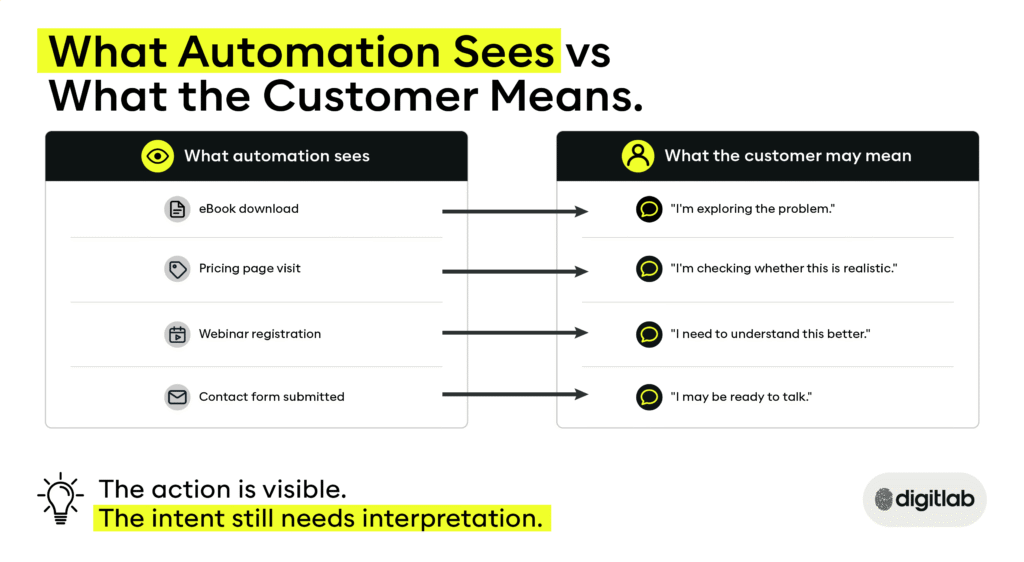
Customer behaviour | Automation logs | Better marketing asks |
Downloads an eBook | New lead | Is this their first interaction, or have they already explored our services and case studies? |
Visits the pricing page | High intent | Are they evaluating suppliers, preparing next year’s budget, or simply checking whether we’re within reach? |
Registers for a webinar | Engagement | What problem are they hoping this webinar will help them solve? |
Returns several times | Repeat visitor | Are they becoming more confident, or are they still struggling to find the information they need? |
Completes a contact form | Sales opportunity | What has convinced them to make contact now, and what questions are they likely to have next? |
Individually, these actions tell you very little. When you view them together, they start to explain how confidence, urgency and intent are developing throughout the buying journey.
This is where businesses stop treating every lead as another workflow and start treating customer behaviour as a conversation. Context helps explain not just what someone did, but why they may have done it. That’s the difference between automating responses and recognising genuine demand.
Demand Is Built Before It’s Captured
One of the easiest ways to diagnose a weak lead generation strategy is to look at where the business believes demand begins. If the answer is “when someone fills in a form”, there’s a good chance the business is already measuring the journey too late.
Long before a prospect even becomes a lead, they have usually been answering a series of questions for themselves.
Is this a problem worth solving?
Is there a better way of doing this?
Which companies seem to understand the challenge I’m facing?
Can I trust them?
Those decisions happen quietly, usually without any interaction with sales or marketing automation. By the time someone finally downloads a guide or requests a demo, many of the important decisions have already been made.
This is why demand generation and automated lead generation perform completely different jobs.
Demand generation helps people reach a decision.
Automation recognises that they have reached one.
That distinction changes the approach because businesses often try to solve weak demand with better automation. They redesign workflows, introduce more lead scoring rules or buy new software when the real issue is that too few people are convinced before they ever enter the funnel.
Before improving your automation, it’s worth asking a more uncomfortable question:
If we removed every form from our website tomorrow, would our content still make people want to work with us?
If the answer is uncertain, the opportunity probably isn’t inside the workflow. It’s earlier in the journey.
Sometimes the Best Automation Does Nothing
A common assumption behind many automation projects is that every customer interaction should trigger another one.
A guide is downloaded, so an email is sent. A webinar ends, so a nurture sequence begins. Someone visits the pricing page, so sales receives a notification.
On paper, all these steps make sense.
In practice, those interactions quickly overlap with conversations the customer is already having. A prospect might already be speaking to sales while the marketing platform continues sending introductory content. An existing customer might receive awareness emails about a problem they’ve already solved. The automation technically isn’t wrong, but it’s not aware of the broader relationship.
This is where mature automation starts to look very different. Rather than looking at what should happen next, it asks whether anything should happen at all.
- Sometimes the most helpful response is to pause a nurture sequence because the customer has entered a sales conversation.
- Sometimes it’s recognising that a long-term client doesn’t need another educational campaign.
- Sometimes it’s allowing a salesperson to take over because context matters more than consistency.
Automation should reduce unnecessary effort for both the business and the customer.
When it continues communicating simply because a workflow says it should, it stops feeling helpful and starts showing a disconnect.
That’s also why response time only becomes valuable when paired with relevance. Responding quickly to the wrong person is still the wrong response. Responding quickly to someone who is genuinely ready to engage is where automation supports better customer experiences.
Technology Doesn’t Improve Lead Quality – Better Decisions Do
One of the reasons we recommend reviewing customer journeys before implementing new automation is that technology doesn’t fixe unclear thinking.
The businesses that consistently generate high-quality opportunities tend to review automation very differently. Instead of asking whether a workflow performed as expected, they ask whether it helped the customer move through the buying journey with more confidence.
Did sales spend less time qualifying poor-fit enquiries?
Did customers arrive with a clearer understanding of the problem they wanted to solve?
Did conversations start at a more informed point than they did six months ago?
Those are often the first signs that automation is supporting better decisions rather than simply creating more activity.
Our work with Fuel to Fly reflected this approach. The objective wasn’t simply to introduce HubSpot or automate more processes. It was to create better visibility across the customer journey, improve qualification and give both marketing and sales the context they needed to have more meaningful conversations.
Technology created consistency. The thinking behind it created the outcome.
That is why businesses looking to strengthen their lead generation strategy often discover that the biggest improvements happen before another workflow is ever built.
Automated Lead Generation Captures Interest – Demand Generation Builds Intent
The biggest shift a business can make with automation is to stop treating every lead as proof of demand.
A form submission, webinar registration or pricing page visit isn’t the conclusion. It’s the start of a much more interesting question.
What does this behaviour tell us about where this customer is in their decision-making?
Businesses that consistently improve lead quality don’t necessarily generate more enquiries than everyone else. They become better at recognising intent. They understand which content builds confidence, which behaviours genuinely signal readiness and which interactions deserve a human conversation instead of another automated email.
That’s why automated lead generation and demand generation should never be viewed as competing strategies. One helps you recognise opportunity. The other helps create it.
Perhaps the most useful exercise isn’t reviewing your workflows. It’s reviewing your assumptions.
If someone downloads your next guide tomorrow, what will your automation assume about them? Would your sales team make the same assumption if they were looking at the same customer?
If the answers are different, the opportunity isn’t to automate more. It’s to understand the people you’re trying to serve.