

Growth has an unusual way of making successful businesses question themselves.
On paper, the right things are happening. Marketing is active. The website is attracting visitors. SEO is improving. Sales are closing. Reports show movement in enough places to suggest the business should feel more confident than it does.
Then the quarterly review arrives, and someone asks the question nobody quite wants to ask: “If all of this is working, why doesn’t growth feel easier?”
It’s a fair question, and usually, the answer isn’t sitting neatly inside one department.
Growth slows when small disconnects form between the activities that were meant to support one another. Marketing may generate demand the website struggles to convert. SEO may build visibility around topics that don’t influence buying decisions. Sales may uncover valuable customer insight that never finds its way back into the marketing strategy. Reporting may show positive movement without explaining where genuine momentum is coming from.
Individually, none of these issues look like a crisis, but together, they weaken growth.
That is one of the biggest misconceptions surrounding a modern business growth strategy. Businesses naturally focus on improving individual activities because those are easiest to measure, isolate and optimise. Sustainable growth rarely comes from making one channel perform exceptionally well. It comes from building a business where every improvement makes the next decision stronger.
That is the difference between activity and momentum.
When Every Department Is Right, But Growth Still Slows
One of the reasons growth can be so difficult to diagnose is that businesses instinctively search for a single point of failure.
Imagine this:
- Marketing says organic traffic has increased by 28%
- Sales says enquiries are taking longer to convert
- Customer success says prospects are arriving with different expectations
- Finance says customer acquisition costs have crept up again
- Operations says the pipeline feels unpredictable
Which department is wrong? Probably none of them.
They are all describing the same growth problem from different vantage points. Marketing is seeing attention while sales is seeing intent. Customer success is seeing expectation gaps. Finance is seeing efficiency, while operations is seeing pressure on the system.
The problem is not that one team has misunderstood the data. The problem is that each team is looking at one path and trying to explain the whole journey.
That is where growth becomes difficult to diagnose. When the issue sits between departments, improving one function in isolation doesn’t solve it. More traffic won’t fix weak conversion. Better reporting won’t fix poor handover. Stronger sales effort won’t fix unclear positioning.
Growth seldom breaks inside one function. It breaks in the spaces between them, where strategy, marketing, website experience, sales process and customer insight are supposed to connect.
Customers Never Experience Your Departments
A customer never thinks: “Now I’m interacting with SEO,” or, “Now I’ve moved from the website into the sales process.”
They experience one business.
That is why growth can’t be understood purely through departmental performance. From the first search to the enquiry form, sales conversation and follow-up, every interaction either strengthens confidence or introduces doubt. The customer is not evaluating channels. They are evaluating whether the business feels clear, credible and easy to move forward with.
This is where disconnected marketing systems create friction.
SEO may attract the right attention, but the website still needs to turn that attention into confidence. A strong website experience can support that journey by making information clear, navigation intuitive and next steps obvious. In the same way, strong search visibility can lose commercial value if users land on pages that create hesitation or lead into a website journey that doesn’t convert.
The point is simple: customers don’t separate these experiences, even when businesses manage them separately. A business growth strategy has to account for the full journey, not just the individual functions contributing to it. 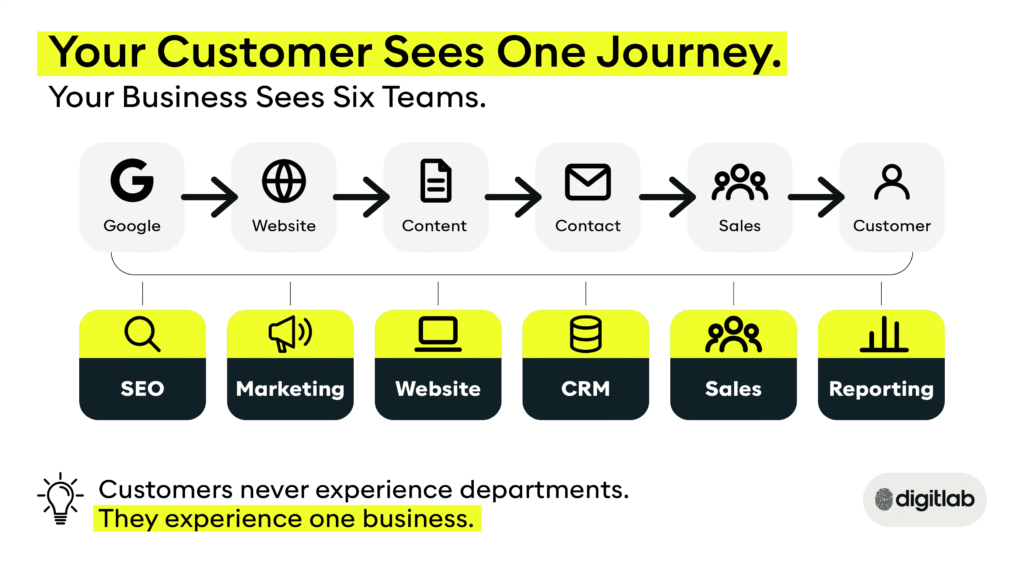
Growth Leaves Clues Long Before Revenue Feels It
One of the easiest mistakes businesses make is assuming the problem they can see is also the problem they need to solve.
If qualified enquiries drop by 30%, the immediate response is to generate more leads. Organic traffic softens, so more content gets commissioned. Sales cycles become longer, so the focus shifts to improving follow-up.
Sometimes those responses are appropriate. Just as often, they address the symptom rather than the cause.
Growth has a habit of leaving clues long before it leaves consequences. The challenge is that those clues don’t always appear dramatic enough to demand attention. They arrive quietly, scattered across different parts of the business, where they are easy to dismiss as isolated issues instead of recognising them as early signals of something larger.
This is one of the reasons sustainable growth requires businesses to become better at recognising patterns, not just measuring performance.
The First Warning Sign Is Rarely the First Thing That Changed
Think about the last time you noticed a decline in business performance.
The conversation probably started with a metric: fewer enquiries, lower conversion rates, slower sales cycles, rising acquisition costs.
Those are important, but they are usually lagging indicators. The first signs appeared much earlier.
Perhaps search trends began shifting towards different customer questions, and competitors started publishing more useful resources around the problems your audience was researching. Website visitors spent a little less time engaging with key pages, and sales teams began hearing the same objections repeatedly, but those insights never made it back into the content strategy.
None of these changes seemed significant on their own. Together, they quietly changed the direction of momentum.
By the Time Revenue Changes, the Story Has Already Started
One of the biggest misconceptions in growth planning is believing that revenue is where performance begins. Revenue is where performance becomes visible.
Long before turnover is affected, businesses start to experience subtle shifts in the quality of traffic they attract, the questions customers ask, the confidence visitors have when exploring the website, or the efficiency with which opportunities move through the sales process. By the time revenue reflects those changes, the underlying causes have already been developing for months.
This is why businesses that only react when revenue changes are almost always reacting too late.
The buying journey itself reinforces this point. Gartner’s research found that B2B buyers spend only 17% of their total buying journey engaging directly with potential suppliers, with the majority of their time dedicated to independent research, internal discussions, and evaluating information across multiple touchpoints.
By the time someone completes an enquiry form or speaks to your sales team, their perception of your business has already been shaped by dozens of smaller interactions. Revenue is simply where those earlier decisions become visible.
Follow the Breadcrumbs, Not Just the Metrics
One of the most valuable habits we’ve developed when working with clients is resisting the urge to fix the first problem we see.
Instead, we ask a different question: “What changed before this changed?”
That simple shift completely changes the conversation and approach.
A decline in lead quality may trace back to changing search intent rather than poor campaigns. Lower conversion rates may have more to do with outdated messaging than traffic volume. Weak commercial performance may start with customer expectations that were set long before someone completed an enquiry form.
Growth leaves clues long before it asks difficult questions. The businesses that grow consistently are usually the ones that learn to recognise those clues before everyone else does.
Revenue Is the Scoreboard, Not the Match
Revenue tells you whether the business is growing. It tells you very little about where that growth was created, where momentum slowed, or which decisions made the biggest difference along the way. A buyer may discover the business through search, compare options through content, revisit the website weeks later, speak to sales, and only convert after several internal conversations. By the time revenue appears in a report, most of the important influence has already happened.
This is where revenue tracking becomes more valuable than revenue reporting alone. Strong revenue tracking does not simply confirm how much revenue arrived. It helps you understand which decisions, channels, pages, conversations, and operational moments contributed to that outcome.
If revenue shows | Challenge it by asking | Why it matters |
Sales increased | What created the quality of demand? | Growth may come from better-fit opportunities, not just more activity |
Pipeline slowed | Where did momentum first weaken? | The issue may have started before sales ever engaged |
Revenue declined | Which earlier signals changed first? | Traffic, conversion quality, lead response, or messaging may have shifted months earlier |
Marketing performed well | Did it create opportunities sales could convert? | Strong channel metrics don’t always equal commercial progress |
A campaign drove revenue | What role did other touchpoints play? | Final-touch attribution can hide the influence of content, SEO, brand, or nurture |
The point isn’t to make reporting more complicated. It is to make it more useful.
Revenue is the scoreboard. It shows the result. A stronger business growth strategy looks at the match itself: where pressure built, where opportunities opened, where momentum shifted, and which plays should be repeated. This is also why businesses need reporting that explains performance, not just reports it.
Growth Becomes Sustainable When Success Reinforces Itself
Businesses often think about compounding in financial terms. Invest consistently, allow time to do its work, and the returns will build on themselves.
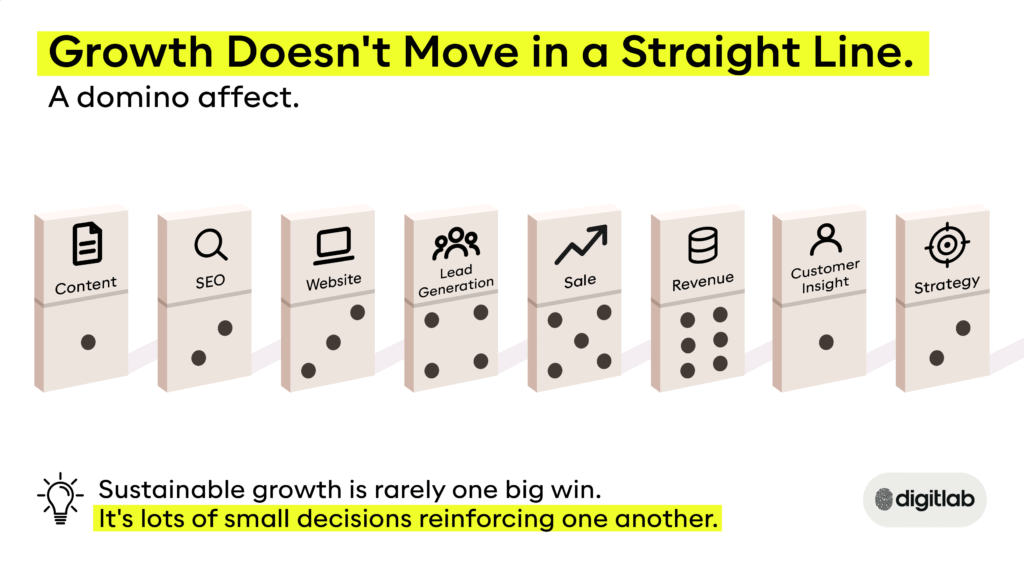
Growth works remarkably similarly. The strongest businesses don’t rely on one exceptional campaign, one high-performing website, or one breakthrough SEO initiative. They create environments where every improvement increases the value of the next.
A well-researched article doesn’t just improve SEO. It attracts more relevant visitors. Those visitors arrive with a clearer understanding of the problem they’re trying to solve. The website reinforces that confidence instead of creating uncertainty. Sales conversations begin at a higher level because prospects are better informed. Customer questions reveal new insights that strengthen the next piece of content, the next campaign, and the next strategic decision.
This is how momentum compounds.
Not because one activity performs brilliantly, but because every decision leaves the business slightly stronger than it was before. Over time, those small improvements stop behaving like isolated wins and start reinforcing one another.
That is what a modern business growth strategy should be designed to create.
The Best Growth Question Isn’t “What’s Missing?”
When growth starts slowing, businesses instinctively ask: “What should we do next?”
You may launch another campaign, increase the budget, or redesign the website while publishing more content. Maybe even hire another agency. Sometimes those decisions are exactly what’s needed.
More often, though, a better question exists: “What should be making the next decision easier?”
Because the businesses that continue growing year after year aren’t necessarily the ones investing the most. They’re the ones building systems where every improvement creates the conditions for the next one.
That’s what a business growth strategy should achieve. Not more activity. A business that becomes stronger every time it grows.