

Marketing may be one of the only disciplines where adding more information often creates more debate.
A finance report generally tells a fairly clear story. Revenue either increased or it didn’t. Costs went up or they didn’t. Operations teams can usually identify whether efficiency improved, declined, or stayed consistent.
Marketing is different. The more data becomes available, the harder some businesses find it to answer relatively straightforward questions. Which activities are genuinely creating growth? Which channels deserve more investment? Why do some campaigns appear successful in reports while contributing very little commercial impact?
This is what makes marketing reporting such an interesting challenge. Businesses have become exceptionally good at collecting information. Dashboards are more sophisticated. Attribution tools are more advanced. Reporting platforms can surface hundreds of metrics across multiple channels in real time. Yet despite all of this visibility, many teams still struggle to confidently connect marketing activity to meaningful business outcomes.
The issue is rarely a lack of data. It’s that reporting often creates confidence in measurement before creating confidence in understanding.
The distinction sounds subtle, though it changes how marketing performance should be interpreted. This is why reporting needs to be connected to a broader digital marketing strategy, not treated as a monthly performance summary.
When the Numbers Look Right but the Picture Doesn’t
A marketing report can sometimes feel like checking your smartwatch after a walk. It tells you the steps, the distance, the calories, the pace, the heart rate. All useful information, but if you felt exhausted halfway through, took the wrong route, and ended up nowhere near where you intended to go, the numbers aren’t telling the full story.
Marketing reporting can work the same way. It may show stronger engagement, increased traffic, or more leads. Those numbers matter, but they don’t automatically tell you whether the business is moving in the right direction. More activity can look like progress when the real question is whether that activity is creating better opportunities, stronger demand, or more confident decisions.
This is where teams need to be careful. If the report only confirms movement, it can make performance feel healthier than it is. The question is “Did the numbers improve in a way that helps us understand what to do next?”
That is where marketing reporting becomes valuable. Not when it makes activity look organised, but when it helps the business see whether the effort is actually taking it somewhere worth going.
The Real Problem Is What the Numbers Are Being Asked to Prove
Marketing data needs to be handled with a healthy amount of scepticism. The numbers aren’t useless, but they’re good at sounding certain before they have been properly understood. A dashboard can show a clean percentage increase, a tidy comparison, and a confident upward trend. That doesn’t mean the business should immediately treat it as proof of progress.
This is why interpretation matters.
A campaign may generate more traffic because it reached a broader audience, not a better one. Lead volume may increase because the barrier to enquiry was lowered, not because demand improved. A channel may appear to perform well because it captured the final click, even though the trust was built elsewhere. The number isn’t wrong, but the conclusion might be.
That’s the gap marketing reporting needs to close. Good reporting should help teams understand what a metric is actually saying, what it’s not saying, and what other signals need to be considered before a decision is made. Traffic should be understood alongside audience fit and engagement quality. Lead generation should be understood alongside valuable opportunity progression. Campaign performance should be understood alongside sales outcomes and revenue tracking.
The strongest reports ask, “Can we trust what this improvement means?”
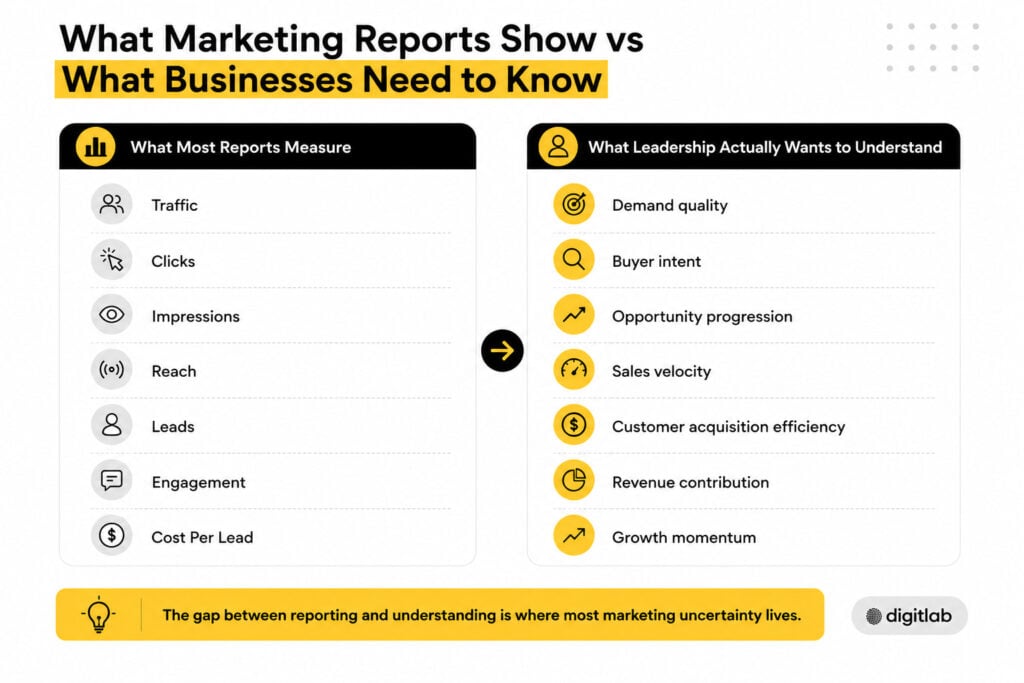
Reporting Shows Movement. Understanding Shows Meaning.
A report can tell you that something changed. That is useful, but only as the first layer. You need to know what the change means.
If one channel generated more leads, did those leads move any further through the sales process? If traffic increased, did it bring in people with stronger intent? If a campaign performed well, did it influence a meaningful decision or simply create more activity?
This is the separation between reporting and understanding.
Reporting gives teams visibility into movement. Understanding the movement helps them decide whether the activity matters. A business can know exactly which campaigns generated the most clicks and still have very little clarity on which activities created real commercial momentum.
The purpose of marketing reporting is to create enough understanding for better decisions to be made.
Buying Journeys Have Outgrown Clean Attribution
Reporting becomes harder when it tries to simplify a journey that has become complex. A potential customer may first see a LinkedIn post that makes them aware of a problem. A week later, they search the topic and read two articles. Later still, they ask an AI tool to compare options, visit a few websites, speak to someone internally, return through a brand search, and only then submit an enquiry.
In the report, that conversion may be attributed to organic search or direct traffic.
Technically, that may be true. Strategically, it’s an incomplete narrative.
The final touchpoint didn’t create the decision on its own. It simply captured a decision that has been forming across several interactions. With AI-driven discovery environments, influence develops long before measurable interaction occurs. Some touchpoints introduced the problem. Another built trust. Others helped the buyer compare options. And the final one simply made it easier to act.
This is why traditional marketing reporting struggles when it tries to assign certainty to one moment in a much longer decision process. The better approach is to understand how different activities contribute to confidence, intent, and eventual action.
Revenue Tracking Gives Reporting Commercial Weight
Revenue tracking brings marketing reporting closer to the outcomes the business is trying to influence. This doesn’t mean every marketing activity must be judged only by immediate revenue. That would flatten the role of marketing and ignore how demand, trust, and brand familiarity build over time. The value of revenue tracking is that it adds commercial context.
A campaign with fewer leads may be more valuable if those leads are better qualified, move faster through the sales process, or convert at a higher rate. A content strategy with modest traffic may still be working well if it supports higher-value enquiries or helps prospects arrive better informed. Without that downstream view, reporting can overvalue volume and undervalue quality.
Revenue tracking helps teams see which activities are contributing to meaningful progress, not just measurable activity. It gives marketing effectiveness a stronger commercial foundation by connecting attention, engagement, opportunity quality, and revenue movement into a more useful story.
Revenue doesn’t replace reporting – it gives reporting something more valuable to explain.
When Positive Metrics Hide the Wrong Problem
Positive metrics can be surprisingly distracting.
A report may show that traffic increased, leads grew, or campaign engagement improved. At face value, that looks like progress. The danger is that these numbers can look strong while hiding a weaker commercial reality underneath.
A website may attract more visitors because content is reaching a broader audience, but that audience may have little buying intent. A campaign may generate more leads because the form is easier to complete, but those enquiries may be less qualified. A channel may appear to perform well because it creates high engagement, while contributing very little to opportunity creation.
This is where isolated metrics become risky. They describe movement without explaining whether the movement is useful.
Positive metric | What it may suggest | What still needs to be understood |
Traffic is increasing | Visibility is improving | Is the audience relevant and high intent? |
Leads are increasing | Demand is growing | Are those leads qualified and likely to convert? |
Engagement is improving | Content is resonating | Is engagement influencing decisions or just attention? |
Cost per lead is decreasing | Acquisition is becoming more efficient | Is lead quality declining at the same time? |
Email clicks are increasing | Nurture is working | Are those clicks moving prospects closer to action? |
Campaign reach is growing | Brand awareness is expanding | Is the reach happening in the right market? |
This is why marketing reporting needs to be interpreted carefully. A number can be positive and still point in the wrong direction if it’s not connected to quality, intent, and commercial movement.
Growth becomes easier to understand when signals reinforce one another. Strong visibility should support better demand quality. Better demand quality should improve conversion efficiency. Improved conversion efficiency should contribute to stronger revenue performance.
Marketing Effectiveness Starts After the Click
Many reporting frameworks become less useful at the exact point where the business needs more clarity. Traffic and clicks are measured, leads are mapped, and then the reporting conversation often slows down, even though the commercial journey has only just started.
That’s where marketing effectiveness should come into focus. A click may show interest, but it doesn’t prove intent. A lead may show activity, but it doesn’t prove quality. A campaign may generate responses, but it still doesn’t prove that marketing is improving the business’s ability to win better opportunities.
The more useful questions sit further downstream.
- Are prospects arriving better informed?
- Are sales conversations becoming more productive?
- Are opportunities progressing faster?
- Is customer acquisition becoming more efficient?
- Are we creating stronger-fit customers rather than simply creating more contacts?
These are the questions that move reporting from performance summaries to business insight.
This is also why a stronger digital marketing strategy needs reporting frameworks that connect marketing, sales, customer experience, and commercial performance. Looking at marketing in isolation rarely gives enough context to understand whether the work is meaningfully improving growth.
Better Reports Start with Better Business Questions
One of the simplest ways to improve marketing reporting is not to start with the dashboard.
Start with the decision the business needs to make.
If the decision is whether to increase investment in a channel, the report should help explain quality, efficiency, and contribution. If the decision is whether a campaign should continue, the report should show whether it’s attracting the right audience and moving them closer to action. If the decision is to improve conversion, the report should identify where momentum is lost.
That shift changes the entire purpose of reporting. Instead of asking, “What happened this month?”, a better report asks:
Business question | What reporting should show |
Are we attracting the right audience? | Audience quality, intent, and fit |
Which activities create the strongest opportunities? | Source quality, conversion rates, and opportunity progression |
Where are prospects losing momentum? | Drop-off points, weak journeys, or slow handovers |
What is influencing conversion rates? | Content, channel, sales readiness, and trust signals |
Which channels deserve more investment? | Efficiency, quality, and commercial contribution |
What should change next quarter? | The next best strategic decision |
This is where reporting becomes valuable because it helps you make better decisions with more confidence.
Reporting Should Create Better Decisions
The problem with most marketing reporting is not that it lacks data. It’s that it struggles to turn data into confidence.
You don’t need another dashboard telling you what happened last month. You need a clearer understanding of what is creating momentum, what is holding performance back, and where the next opportunities are.
That’s what separates useful reporting from reporting that looks impressive. The real value of reporting isn’t in measuring activity – it’s in helping a business make better decisions with greater certainty.