

A marketing strategy doesn’t fail overnight with a big ‘system failure’ sign pulsing on a screen like something out of a sci-fi film. There is very rarely a dramatic moment where performance suddenly collapses, leads disappear, or growth grinds to a halt. Some of the most concerning strategy problems develop while everything still appears relatively healthy on the surface.
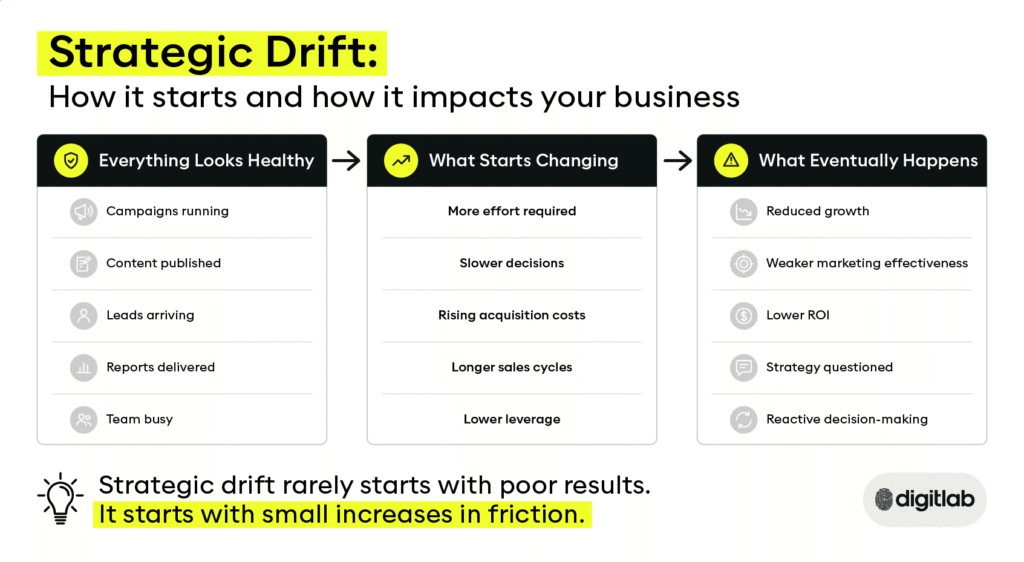
Campaigns still run. Content is still being published. Reports are still being shared. Teams remain busy. From the outside, it can look like the strategy is working because the activity surrounding it is always visible and moving.
The effectiveness of a strategy and the activity it produces aren’t always the same thing.
A business can consistently publish new content while the assumptions supporting that execution gradually become less relevant. Customer behaviour changes. Competitors adapt. Markets evolve. New channels emerge. Expectations shift. The strategy keeps moving, but the environment around it changes. This is where strategic drift begins.
Strategic drift occurs when a marketing strategy continues operating on assumptions that were once valid but have become less effective over time. The challenge is that businesses rarely notice it immediately because the warning signs appear long before the results catch up.
That makes strategic drift one of the most overlooked threats to long-term marketing effectiveness.
Most Marketing Strategies Don’t Break. They Drift.
When we think about strategy failure, we often imagine something dramatic. The dramatic crash and burn of a failed campaign. A major drop in performance. Leads suddenly disappearing.
A marketing strategy loses its effectiveness far more gradually.
A strategy may have been built around a specific customer behaviour pattern, competitive landscape, or acquisition channel. At the time, those assumptions made perfect sense. They may even have been the truest reflection of where the business was.
The reality is that markets don’t stand still:
- Search behaviour changes
- Buying journeys evolve
- New competitors enter the market
- Customer expectations shift
- AI and technology influences how decisions are made
Over time, the environment the strategy was designed for starts looking very different from the environment it’s operating in. The strategy itself may not be wrong, but it becomes less relevant.
This is why strategic drift is often difficult to identify. Businesses aren’t evaluating a broken strategy. They are evaluating a strategy that is gradually losing alignment with business reality.
Every Strategy Is Built on Assumptions
At its core, every marketing strategy is a collection of assumptions.
We assume where customers spend their attention. We assume what influences decision-making. We build strategies on assumptions about how people evaluate solutions, compare providers, and choose who to trust.
Many of these assumptions are invisible once a strategy is established.
Teams become familiar with the channels they use, the messaging they communicate, the campaigns they run, and the reports they review. The strategy feels normal because it’s become part of how the organisation operates.
“The danger is that assumptions don’t announce their expiration dates.”
A channel that consistently generated demand two years ago may not perform the same way today. Messaging that once differentiated the business may become common across an industry. Customer priorities may shift without appearing immediately in reporting.
This is why the strongest marketing strategies aren’t static documents. They are systems that continuously challenge the assumptions they were built upon.
Activity Is a Poor Indicator of Strategic Health
One of the biggest reasons strategic drift goes unnoticed is because activity creates reassurance.
The work is happening, campaigns are launching, content calendars are followed, reports are arriving on schedule, and meetings are taking place. The presence of activity makes it easy to assume there is momentum.
Yet activity and effectiveness are measuring two completely different things.
A strategy can generate a large volume of activity while steadily becoming less effective at influencing valuable business growth. Some organisations respond to weakening performance by increasing activity further. More campaigns are launched. More content is created. More channels are added. The assumption again, is that more effort will restore momentum.
This is often where businesses start questioning their channels, campaigns, or suppliers when the real issues sit higher up in the digital marketing strategy.
Sometimes the issue isn’t effort. Sometimes it’s that the strategy itself is drifting away from the conditions it was designed to address.
Driving Faster Doesn’t Help If the Map Is Outdated
Imagine driving across Johannesburg using a map that hasn’t been updated in years.
You may be moving quickly and even following directions confidently. You may be investing significant effort into reaching your destination.
The problem is that the roads have changed in recent years. New routes exist. Traffic patterns have shifted. Entire areas may have developed differently from what the map suggests. The issue is not the quality of the driving. The issue is the quality of the guidance.
Marketing strategy can experience the same problem. Execution can be strong while the assumptions guiding that execution progressively become less accurate.
The First Warning Sign Is Usually More Effort for the Same Outcome
One of the earliest signs of strategic drift is rarely a collapse in performance. It’s friction. Businesses start noticing they need more effort to achieve outcomes that once came more naturally.
More content is needed to maintain visibility levels. More advertising spend is required to generate and maintain similar lead volumes. Sales teams work harder to create the same number of opportunities. Nurture sequences become longer and decision cycles become slower.
None of these changes appears as red flags in isolation. Collectively, however, they often indicate that the strategy is losing its effectiveness.
The business continues moving forward, though the cost of maintaining momentum steadily increases. This is often where strategic drift first becomes visible.
Not through failure. Through diminishing leverage.
When Marketing Planning Becomes Calendar Management
One of the more subtle forms of strategic drift we often see is when marketing planning becomes heavily focused on execution schedules rather than strategic intent.
The content calendar is full and campaign dates are locked in. Budgets are allocated.
Deliverables are assigned. And everything appears organised.
What lies beneath the activity is often a more important question: are all these efforts actually improving marketing effectiveness, or simply keeping the machine moving? Organisation creates structure, but structure alone doesn’t guarantee progress.
Strong marketing planning should help businesses prioritise opportunities, test assumptions, and adapt to changing conditions. Weak planning simply ensures activity continues regardless of whether the underlying strategy still deserves confidence.
This is one of the reasons marketing teams sometimes find themselves executing exceptionally well against priorities that aren’t creating meaningful advantage.
The planning process is active, while the strategic thinking gradually fades into the background.
Marketing Effectiveness Is Usually Lost Before It Is Measured
One of the reasons strategic drift is so difficult to diagnose is that measurement lags behind reality. A strategy may lose effectiveness long before reporting reflects the change.
Brand familiarity built over several years continues to generate demand. Existing search visibility continues attracting. Established customer relationships continue producing referrals.
Historical momentum creates a deceiving buffer. For a period of time, results appear relatively stable even though the strategic foundations underneath them have already become weaker.
This is why businesses should be cautious about treating current performance as proof that a strategy is healthy. In many cases, the challenge isn’t identifying what changed. It’s understanding whether the signals you’re measuring still reflect the health of the strategy underneath them.
Strong results today are sometimes the outcome of decisions made months or even years ago. This is particularly important when evaluating long-term SEO performance, where visibility can remain stable even as the factors supporting future growth begin to weaken.
By the time performance clearly reflects strategic drift, the underlying causes have often been developing for much longer.
What to Do When Strategy Starts Drifting
Constant reinvention of the brand or services isn’t going to solve a strategy problem.
Businesses don’t need a completely new marketing strategy every quarter either. What they need is a process for regularly challenging assumptions.
Asking questions related to the current business reality like:
- What has changed about our customers’ buying behaviour?
- Which channels are becoming more or less influential to us?
- What assumptions are we still operating on?
- Which activities feel habitual rather than intentional?
- If we were building this strategy today, what would we do differently?
These questions create the space for strategic adjustment before performance starts suffering significantly. The goal is not chasing trends and channels and jumping on the latest viral ‘marketing hack’. It is to ensure the strategy is aligned with the reality it is intended to influence.
Strategic drift is rarely solved through a new campaign. It’s solved by reconnecting marketing decisions to current customer behaviour, commercial priorities, and operational realities.
The Best Marketing Strategies Continue Earning Their Relevance
A useful question for any leadership team is this:
If you were building your marketing strategy from scratch today, knowing what you know now about your customers, competitors, and market, would you make the same decisions?
Most businesses never stop to ask it. Instead, strategies often become inherited documents. Activities continue because they have always been done. Budgets remain allocated because they were allocated last year. Assumptions survive because nobody challenges them.
The risk is not that a strategy stops working overnight – but that it becomes familiar enough to avoid scrutiny.
Strategic drift is rarely about making the wrong decisions. More often, it’s about continuing with old decisions long after the conditions that justified them have changed.
The businesses that maintain marketing effectiveness aren’t necessarily the ones with the best plans. They are the ones willing to regularly question whether their current plan still deserves their confidence.