

Lead management automation is the set of rules a CRM uses to score, route, assign and follow up with leads automatically. Rules that were accurate when someone built them, but rarely get reviewed once they’re live. The technology doesn’t just move leads through a pipeline. It makes ongoing judgements about who gets attention and when, often long after the assumptions behind those decisions have quietly gone out of date.
One of the easiest tells of whether a CRM has started to drift off course comes from asking one surprisingly simple question during a pipeline meeting: “Why is this lead still sitting here?”
Sometimes nobody knows.
Marketing assumed sales was following up. Sales thought the lead belonged to marketing. The workflow assigned an owner months ago, but that person changed roles. The lead score still suggests a promising opportunity, even though the prospect hasn’t engaged with anything for weeks.
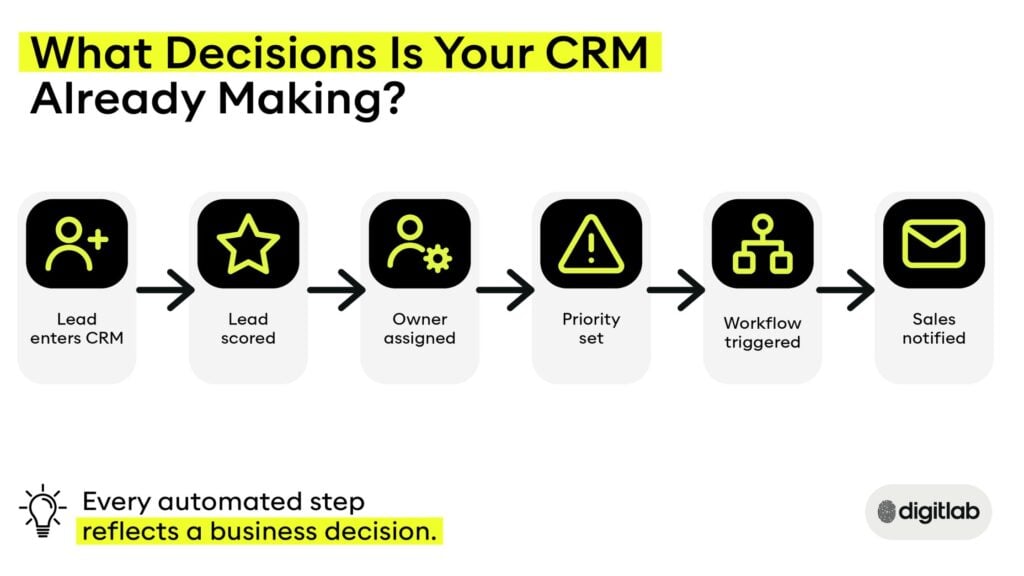
Nothing appears broken. The CRM is running as it should. Notifications are being sent. Tasks are created. Reports continue to fill with activity. Yet every one of those automated actions is based on evaluations the business made at some point in the past. Who owns this lead? When should it move? What counts as qualified? When should sales become involved? Those decisions shape every customer journey long before anyone picks up the phone.
This is why lead management automation deserves far more attention than it usually receives. The technology isn’t simply moving leads through a CRM. It’s making hundreds of operational decisions every day, often without anyone asking whether those still reflect the way the business sells today.
The question isn’t whether your CRM is automated – it’s whether your system is still using business logic you would make yourself.
Every Automated Rule Is Quietly Making Business Decisions
Automation isn’t just for saving time. Efficiency is certainly one outcome, but it isn’t the most important one. Every automated workflow also makes assumptions on behalf of the business.
It decides whether a lead should go to sales or remain in marketing. It decides when follow-up should happen, who owns the relationship, how engaged someone appears and whether they deserve more attention than the hundreds of other prospects sitting in the CRM.
Imagine hiring a new salesperson who immediately has to start assigning leads, changing priorities and deciding which enquiries deserve urgent attention. You’d probably spend weeks reviewing those decisions, coaching their judgement and making sure they understand how your customers actually buy.
Automation doesn’t receive the same level of scrutiny.
Once a workflow is built, there’s a natural tendency to assume it continues to make good decisions indefinitely. Those decisions still age just like sales processes, customer expectations and markets do.
That’s why reviewing the CRM shouldn’t begin with the routing logic itself. It should start by asking a much simpler question: Would we still make these decisions today?
Your CRM Already Has an Opinion About Every Lead
Every lead inside your CRM is being classified, whether anyone realises it or not.
- A score classifies how valuable the opportunity appears to be.
- A routing rule determines who should take ownership.
- A lifecycle stage classifies where the customer is believed to be in their buying journey.
- A task reflects what the CRM believes should happen next.
None of those labels are facts. They’re classifications based on assumptions your business chose to automate. That distinction matters because customer behaviour evolves much faster than CRM logic used to classify it does.
A prospect downloading a buying guide may have represented strong intent 18 months ago. Today, the same action could simply reflect someone gathering information with the help of AI before they’ve even shortlisted potential suppliers. The customer has changed, but the CRM rule may still be treating that behaviour exactly as it always has.
Good sales lead automation isn’t just about moving leads efficiently. It’s about making sure the way your CRM classifies people still matches the way they actually buy.
The Leads You Should Worry About Aren’t the Loudest
When businesses review their CRM, attention naturally goes towards active opportunities.
Who’s close to signing?
Which deals are progressing?
Where is the next quarter’s revenue coming from?
The more revealing questions usually sit somewhere else.
Which leads have silently stopped moving?
Which opportunities have changed owners three times?
Which prospects have been “waiting for follow-up” for six weeks without anyone noticing?
These aren’t dramatic CRM failures. They’re silent ones. Lead management automation can create the comforting impression that every enquiry is progressing because every lead has a status, an owner and a workflow attached to it.
Movement inside a CRM doesn’t always represent momentum in a customer journey.
Sometimes it simply reflects administration.
What the CRM says | What might actually be happening |
Waiting | Nobody knows who owns the next conversation |
In nurture | Sales decided months ago the lead wasn’t ready |
Marketing Qualified | Marketing and sales define “qualified” differently |
Opportunity Open | The customer hasn’t responded in weeks |
Closed Lost | Nobody captured why the opportunity disappeared |
The healthiest CRM isn’t the one with the most processes running. It’s the one where every stage still reflects reality.
There’s a Name for What’s Happening: Decision Debt
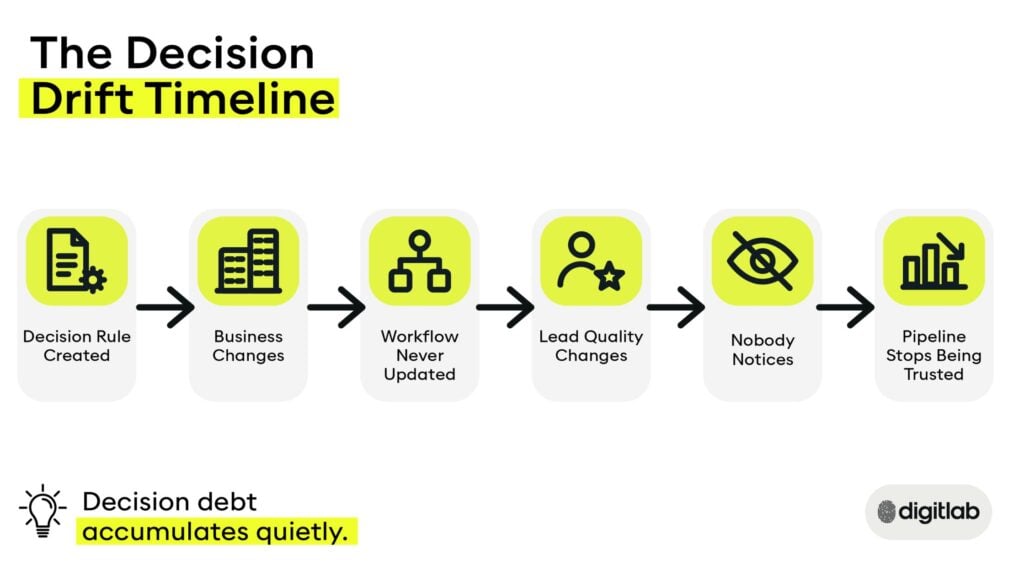
Software teams have a term for code that technically works but was never revisited as circumstances changed: technical debt. It doesn’t stop the system from running. It just makes every future change riskier, slower and harder to trust.
CRMs accumulate the same problem. Call it decision debt: every rule, lead score weight and routing condition that made sense when it was built, but hasn’t been checked against how your business actually sells today.
Decision debt doesn’t show up as an error. It’s a little like leaving old road signs in place after the roads have changed. Drivers continue following the signs because they trust the system, even though the destination no longer matches reality. It shows up as a lead sitting in “nurture” for four months because the rule that put it there was written for a buyer journey that doesn’t exist anymore. It shows up as a routing condition still splitting leads by a sales structure you reorganised last year. Nothing breaks. Nothing throws a warning. The CRM just keeps quietly executing sales thinking nobody currently agrees with.
Like technical debt, it stacks up. The longer a rule runs unquestioned, the more reports, forecasts and sales behaviours get built on top of it, and the harder it becomes to tell which parts of your pipeline reflect reality and which parts just reflect stagnation. We’ve found that businesses rarely notice decision debt during implementation. They notice it 18 months later when nobody quite trusts the CRM anymore, even though nobody can explain exactly why.
Better Lead Management Starts with Better Questions
Many CRM projects start by asking: “What should happen after someone submits this form?”
A more valuable question is: “What decision are we trying to make?”
Those aren’t the same conversation. The first produces workflows. The second produces better judgement that would guide the process.
For example, instead of asking how quickly a lead should be routed, ask what information someone needs before they’re genuinely ready for a sales conversation. Instead of refining lead scores, ask which customer behaviours have consistently appeared before your highest-quality opportunities were closed.
When process is built around better questions, it becomes significantly easier to adapt as customer behaviour evolves. The workflow isn’t just following rules; it’s supporting decisions the business understands and continues to believe in.
This is also where strong CRM software becomes more than a database. It becomes a decision-support system that helps marketing and sales work from the same understanding of the customer journey.
Reasoning Quality Deserves a Dashboard Too
Imagine opening your CRM dashboard on Monday morning.
The numbers look healthy. Lead volumes are up. Response times are on target. Pipeline value has increased.
What the dashboard can’t tell you is whether the right opportunities were prioritised, whether ownership made sense, or whether your automation is still making decisions your sales team would agree with.
That distinction matters because automation is only as reliable as the information and reasoning behind it. Validity’s 2025 CRM research found that 76% of CRM users believe less than half of their CRM data is accurate and complete, despite almost every organisation considering CRM data fundamental to their operations.
This is why we encourage businesses to think more broadly about revenue operations metrics. Strong reporting shouldn’t just explain what happened. It should help you judge whether the reasoning behind your CRM is still creating good outcomes.
Because before building another workflow, it’s worth asking whether your dashboard is measuring activity…or whether it’s helping you trust the thinking behind it.
A Five-Minute Decision Debt Audit for Your Next Pipeline Meeting
You don’t need a CRM overhaul to start finding decision debt. You need five questions and a pipeline report open on screen.
- Pick the three leads that have sat in the same stage longest. Ask who owns the next action out loud, in the meeting. If nobody answers immediately, that’s decision debt.
- Find a lead scoring rule that’s more than a year old. Ask whether the behaviour it rewards (a download, a page visit, a demo request) still means what it meant when the rule was written.
- Check who a lead gets routed to when a form is submitted today. Confirm that logic still matches your current team structure, not last year’s.
- Look at your “Closed Lost” reasons. If most are blank, generic, or “no response,” your CRM isn’t capturing why decisions failed. It’s just recording that they did.
- Ask the room: would our best salesperson make the same call this workflow just made? If the honest answer is “probably not,” you’ve found your next fix.
Run this quarterly, not once. Decision debt doesn’t accumulate all at once, it builds one unreviewed rule at a time.
Good Automation Makes Better Decisions Feel Obvious
One of the reasons CRM projects become frustrating is that businesses naturally focus on what the software can do.
Route leads.
Assign owners.
Send reminders.
Create tasks.
Those capabilities matter.
What matters more is whether they consistently support the evaluations your teams would make if they were sitting together around the same table.
Businesses that get the greatest value from lead management automation rarely have the most complicated workflows. They have the clearest understanding of how customers move through their buying journey and the discipline to review whether their systems still reflect that reality.
That’s also why many organisations find that improving their broader lead generation strategy makes automation significantly more effective. Better demand creates better opportunities, and better opportunities make better process logic possible.
As we explored in why CRM software fails without leadership discipline, technology performs best when it reflects shared business decisions rather than replacing them.
Your CRM Is Already Deciding. The Question Is Whether You Still Agree.
The real opportunity isn’t building more workflows. It’s making sure the logic inside those workflows still reflect the way your business understands customers today.
Because the quality of your lead management automation has very little to do with how many tasks it creates. It has everything to do with whether your best salesperson would make the same decision if they were looking at the same lead.
If that question feels difficult to answer, you’ve probably found the next place your CRM deserves attention. It’s usually where we start too.