

The Zero-Click Era Is Already Shaping Behaviour
The idea of zero-click search has been around for a while. What’s different now is how widely it’s experienced. Users are getting what they need much faster, often within the search interface itself. AI-generated summaries, featured snippets, and direct answers compress the research process into a single step. The need to visit multiple pages reduces as the platform does more of the interpretation for users.
We clearly see this shift show up in performance patterns, with a growing share of searches now ending without a click, as users get what they need directly from the results page or AI-generated responses. The implication is straightforward. Visibility doesn’t guarantee attention, and attention doesn’t guarantee interaction.
Our 2026 Digital Insight Report highlights a similar challenge. While 57% of organisations increased their marketing investment, many still rely on intuition rather than real-time customer data to evaluate performance. As search becomes increasingly zero-click, that measurement gap widens. Visibility may still exist, but traditional metrics such as traffic and engagement no longer tell the full story.
Traffic still plays an important role, though it now represents only a portion of how visibility contributes to performance.
Where the Search Journey is Being Shortened
The search journey used to involve a sequence of decisions. A user would search, scan results, visit a few sites, and build an understanding before deciding what to do next. That process is being compressed into a single interaction.
Instead of moving between multiple sources, users are presented with a consolidated response that reflects the most relevant information available. The comparison and evaluation that used to happen across several pages now happens within the search experience itself. This fundamentally changes where decisions are made.
Search platforms now handle much of the evaluation phase by interpreting the query based on intent, assessing available information, and presenting a consolidated response. The user interacts with that response rather than the individual sources behind it, shifting the moment where influence happens – moving the journey from the website to the search experience itself.
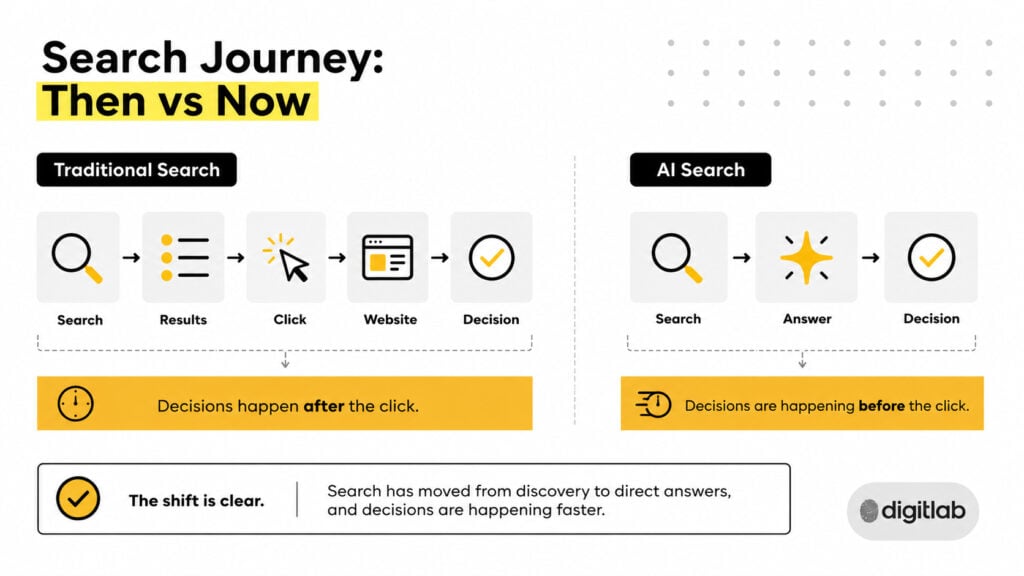
This compresses the window where brands can influence decisions. If your content isn’t part of that initial response, it becomes significantly harder to enter the conversation later.
What Makes Content Useful Before the Click
In answer-driven search, content is not only competing for a ranking position. It is competing to be useful inside the answer itself. That changes what “good” content needs to do.
A page may rank well, but if the answer is buried, vague, unsupported, or too dependent on the user reading the full page, it becomes harder for search engines and AI systems to reuse confidently.
Content is more likely to be surfaced in answer-led search when it helps the search experience do three things quickly:
- Understand the question.
- Extract a clear answer.
- Trust the source enough to use it.
This is why practical clarity matters. Definitions should be easy to identify. Explanations should answer the question directly before adding depth. Claims should be supported. Examples should make the point easier to understand, not simply fill space.
The goal is not to write shorter content. It is to make the useful parts easier to find, interpret, and trust.
This is where many businesses begin to notice the difference between SEO and AEO. A page can still be valuable as a full article, guide, or resource, but the key answer should not be hidden halfway down the page. In the zero-click era, the first job of content is often to help the search experience understand the answer before the user ever arrives.
That means content needs to work in two places at once: inside the search result, where the answer may be formed, and on the website, where deeper engagement can still happen.
This is why content quality is being redefined. It’s not about how well a page reads, but how effectively it answers a question in a way that can be reused. We explored this in why SEO doesn’t always translate into revenue, where visibility alone doesn’t determine impact.
Why Rankings Don’t Translate into Traffic the Same Way
Ranking still plays a role in visibility. The outcome it drives is what’s changed. A user may see your page in search results. At the same time, they may already have the information they need before clicking through to one of your pages. This creates a disconnect between what’s being measured and what’s actually happening.
This is the trap. Businesses optimise for rankings, measure impressions, and expect traffic to follow, even though the mechanics of search have shifted. Traditional reporting frameworks don’t always account for this. They focus on impressions and position, while the actual interaction happens elsewhere entirely.
That gap is where much of the current confusion comes from, particularly for teams still measuring success using models that don’t reflect how users interact with search.
What This Means for Marketing Effectiveness
Answer-driven search introduces a different way of thinking about how we approach performance. Traffic is (and always will be) valuable, but it’s not the only indicator of influence anymore.
Being part of an answer contributes to how users understand a topic (get information), evaluate options (navigate), and form decisions (act). That influence isn’t always captured through clicks, but through topical authority resulting in citations and mentions. This creates a disconnect between what is measured and what is actually influencing decisions.
A brand may contribute to how a user understands a topic, shapes their preference, or shortlists a solution, without ever seeing that reflected in traditional engagement metrics. That’s where the definition of effectiveness needs to evolve.
It’s also where traditional definitions of marketing effectiveness become unclear. If success is measured purely through traffic, answer-driven visibility looks like a decline. In reality, influence is still happening, just far earlier in the journey and outside of traditional tracking models.
This creates a measurement gap. Teams are reporting on activity, while influence is happening outside of those metrics, and starts to feel like performance is slipping, even when visibility remains strong.
What This Shift Requires from SEO Strategy
This shift does not mean businesses should stop investing in SEO. It means SEO strategies need to account for how search behaviour has changed.
For years, the goal was clear: improve rankings, increase clicks, grow traffic.
Those outcomes still matter, but they no longer tell the whole story. In the zero-click era, a user may see your brand, absorb your answer, compare your perspective, and move closer to a decision without ever visiting your website.
That means your SEO strategy needs to work harder before the click.
Content still needs to be discoverable. What has changed is where it creates value. Increasingly, that value comes from helping users understand a topic before they ever visit your website. Reporting also needs to evolve, because traffic alone may understate the value search is creating.
This is where businesses need to look beyond rankings and sessions. Impressions, featured snippets, AI citations, branded search growth, assisted conversions, and changes in lead quality all become more important signals.
The question is no longer only: “How much traffic did SEO generate?”
It is also: “Where is our brand showing up when people are forming their answers?”
That is the strategic shift. SEO still creates the foundation for visibility. AEO helps ensure that visibility is useful before the user ever clicks.
AEO Extends SEO Rather Than Replaces It
There’s a tendency to separate Answer Engine Optimisation from SEO. In reality, they are part of the same progression.
SEO creates the conditions for visibility.
AEO determines how that visibility is used.
The fundamentals haven’t disappeared. Relevance, clarity, and usefulness still matter, but the way those elements are interpreted has evolved.
The Future of Search Is Already Taking Shape
Search is becoming faster, more selective, and more efficient. Users expect answers quickly, and platforms are designed to deliver them. This changes what it means to be visible.
Presence alone isn’t enough. Content needs to be clear, credible, and structured in a way that allows it to be included in the response itself. That’s where Answer Engine Optimisation becomes less of a concept and more of a requirement.
Because in this environment, traffic is only one outcome. Being part of the answer is the shift that will define how visibility translates into influence going forward.