

One of the easiest ways to spot an ageing marketing automation system is that nobody wants to touch it anymore. Not because it isn’t working, but because everyone assumes it is.
The emails send on time. The lead scores update. The CRM tasks appear where they should. Nothing looks broken, which makes it very easy to assume the system is doing its job.
Then, months later, someone asks why prospects are still confused, why sales is following up on low-fit leads, or why a customer who has already signed still receives a “ready to book a demo?” email.
That is usually the moment automation stops looking efficient and starts looking uncomfortable. The software did what it was told to do. The workflow followed the rules. The problem is that nobody questioned whether those rules still made sense.
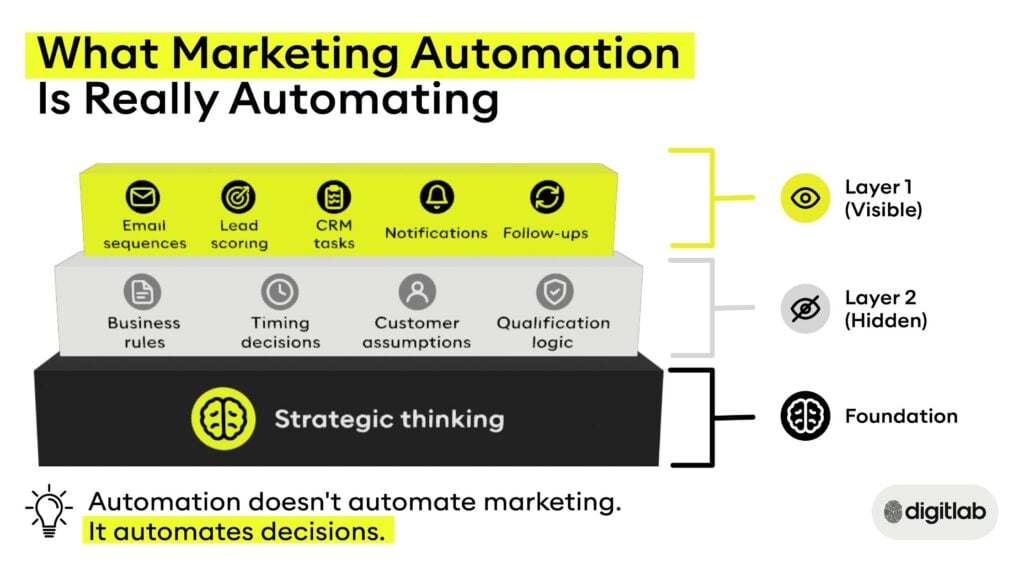
That is the real risk with automation. It doesn’t improve strategy by default. It operationalises the decisions, assumptions, and customer journeys already built into the business. If those decisions are clear, automation can create consistency, relevance, and momentum. If they are unclear, automation simply makes the confusion repeatable.
Every workflow is a business decision repeated at scale.
That is why the best automation work rarely starts inside the platform. It starts by asking what the customer should experience, what the business is trying to achieve, and whether the logic being automated still deserves to exist.
Automation Doesn’t Know When the Logic Has Expired
One of the biggest differences between people and automation is curiosity.
People question.
Automation repeats.
A person may notice that prospects are asking different questions this quarter. Sales may hear that buyers are comparing new competitors. A marketer may realise that a nurture sequence feels slightly out of step with how customers make decisions now.
Automation won’t notice any of that.
It will keep sending the same emails, assigning the same scores, triggering the same tasks, and moving people through the same journey because the rules still technically work. That is where automation starts feeling uncomfortable. The workflow may be functioning perfectly, while the thinking behind it has become outdated.
This is not a software problem. It’s a logic problem.
Every workflow reflects decisions someone made at a specific point in time. What should happen after a lead downloads this asset? How long should we wait before following up? What does this behaviour tell us about intent? Which message should come next?
Those decisions may have been right when the workflow was first built. The risk is that customer behaviour, sales conversations, product priorities, and buying expectations change while the automation continues to repeat the original logic as if nothing has shifted.
One of the patterns we’ve noticed is that businesses rarely remove marketing automation workflows because they stopped working. They keep it because nobody feels confident enough to question it.
Every Workflow Is a Decision Repeated at Scale
A workflow may look like a sequence of emails, CRM actions, delays, lists, scores, and notifications. Underneath, it’s a set of assumptions.
- It assumes the lead is at a certain stage.
- It assumes the next email is relevant.
- It assumes three days is the right delay.
- It assumes one action signals interest while another signals low intent.
- It assumes the customer journey is still behaving the way it did when the workflow was first built.
None of those assumptions are automatically wrong. The problem starts when they stop being reviewed and questioned.
“Automation doesn’t separate good assumptions from outdated ones. It repeats both with the same confidence.”
That’s why ageing workflows can create confusion: not due to a failed automation, but because the business decisions inside the automation were never challenged again.
“Automation should reduce thinking for the business, not for the customer.”
Good Automation Doesn’t Feel Like Automation
The best marketing automation usually disappears into the experience.
A prospect downloads a comparison guide because they are weighing up options. The next email doesn’t welcome them into a generic newsletter sequence or send them back to beginner-level content. It recognises that they are already evaluating. It helps them compare. It answers the question they were likely to ask next.
That is what relevance feels like.
Customers rarely care whether an interaction was automated or manual. They care whether it made sense in the moment. Did it respect what they had already done? Did it move the conversation forward? Did it make the next step easier? They care whether the business appears to understand where they are in the journey. Interestingly, this is also one of the reasons CRM implementations struggle when technology is expected to solve problems that actually belong to process and leadership.
That is where strong automation becomes almost invisible.
Weak automation draws attention to itself because it feels disconnected. The timing is off. The message feels generic. The follow-up ignores previous behaviour. The customer gets treated like a new lead even after they have clearly moved further along the journey.
Strong automation does the opposite. It connects the dots between behaviour, intent, timing, and context. One relevant email sent at the right moment will almost always outperform five perfectly scheduled emails that answer questions the customer stopped asking weeks ago.
The goal isn’t more workflows. It’s creating interactions that feel considered, even when they are automated. That is where marketing automation starts supporting trust rather than simply increasing activity.
More Workflows Can Make the Journey Feel Less Intelligent
Not every automation issue requires another workflow.
Imagine this:
A prospect downloads a pricing guide. The automation sends five educational emails explaining the basics of the industry. Meanwhile, the prospect was already comparing suppliers and simply wanted reassurance before requesting a quote.
The workflow worked. The customer journey didn’t. This is one of the clearest signs that automation has become disconnected from intent.
Instead of helping customers move forward, it keeps treating everyone as though they are at the same stage. Automation isn’t there to create more customer interactions. It’s there to reduce the number of interactions needed to help someone move forward confidently.
What the workflow says | What the customer experiences |
Welcome sequence started | “I’ve already spoken to sales.” |
Educational email sent | “I already know this.” |
Lead score increased | “Why hasn’t anyone followed up properly?” |
Task assigned | “Why do I need to repeat myself?” |
Workflow completed | “That felt automated, not helpful.” |
A good marketing automation workflow should reduce the effort required from the customer. It should help the business respond with more relevance, not simply with more touchpoints.
The goal isn’t to create more automated activity. It’s to help the right opportunities move through the journey with less friction.
Great Marketing Automation Starts Before the Software
The most useful automation conversations rarely begin inside the platform. It starts with understanding what the customer is trying to achieve before anyone opens the flow.
Before building a workflow, the business needs to understand what the customer is trying to do at that moment. Are they learning? Comparing? Hesitating? Waiting for reassurance? Trying to speak to someone? The answer changes what automation should do next.
One of the first questions worth asking is, “Which decision are we trying to repeat?” Those repeated conversations aren’t just sales insights – they are signals that the customer journey is asking automation to solve a communication problem instead.
A pricing-guide download, a webinar registration, and a contact form submission shouldn’t all be treated as interchangeable actions. They signal different levels of intent. They require different follow-ups. They tell the business something different about where the prospect might be in the buying journey.
The strongest automation comes from mapping these moments before the technology is configured. Where do customers become uncertain? Which questions does sales answer repeatedly? Where does follow-up slow down? Which moments need speed, and which moments need human judgement?
Only once those questions are clear does the software become useful.
That is why businesses investing in automation should strengthen the customer journey first. Clearer journeys create better automation because the technology has stronger decisions to repeat. It’s also why a strong lead generation strategy should inform automation, not sit behind it. Automation should support demand generation, not try to compensate for an unclear strategy.
Marketing Automation Should Scale Judgement, Not Just Activity
The best automation doesn’t make a business feel busier. It makes the business respond better.
That’s the real test. Not how many workflows exist, how many emails are scheduled, or how many tasks are triggered, but whether the automation actually helps the business make better decisions at the right moments.
That is the standard worth holding automation to. Because automation doesn’t create great marketing on its own. It repeats whatever thinking the business chooses to build into it.
So the question is not whether your business should automate more – it’s whether your automation is repeating decisions you would still make today.