

The March and May 2026 Google core updates didn’t arrive with dramatic warning signs. There was no obvious penalty notification, no mass disappearance from search overnight, and no single explanation businesses could point to.
Instead, the changes were quieter.
- A service page that consistently generated enquiries suddenly slowed down. Rankings looked unstable without collapsing entirely.
- Organic traffic still existed, though the quality of engagement started feeling different.
For many businesses, the first sign that something changed wasn’t traffic loss. It was uncertainty around why visibility isn’t translating into the same commercial momentum.
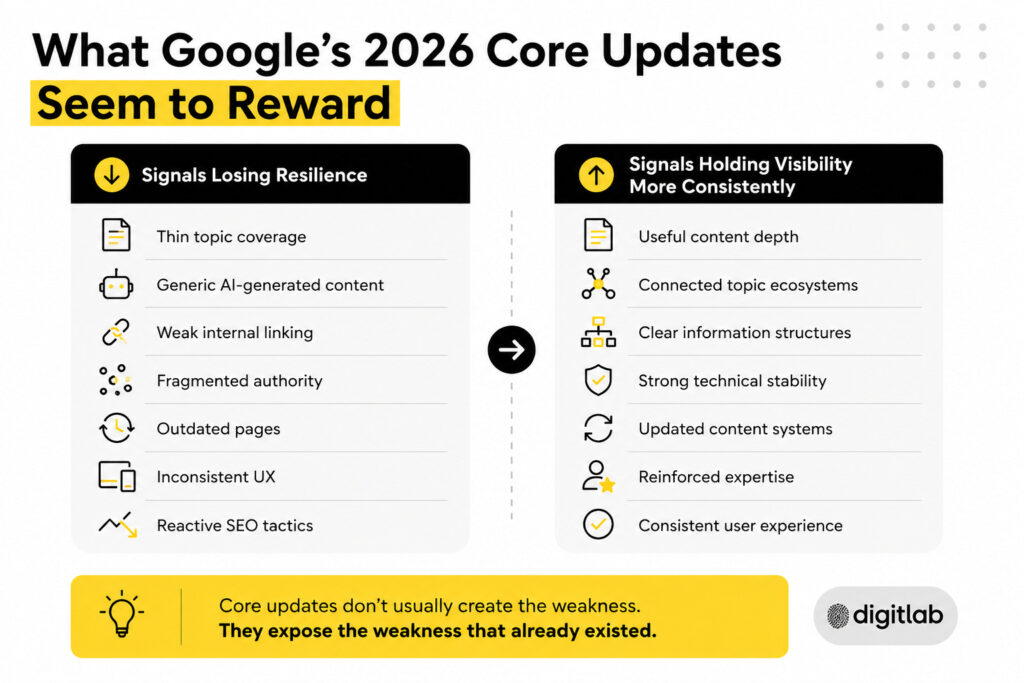
That is often how modern Google core updates behave. They rarely create entirely new SEO problems. More often, they expose structural weaknesses that were already sitting beneath the surface.
Weak topic structures with shallow content depth. Technical friction and fragmented authority signals. Content systems that looked productive on paper quietly lost contextual strength over time.
The March and May 2026 updates seem to reinforce something search has been moving toward for years already. Visibility is tied to clarity, usability, trust, connected expertise, and overall experience quality rather than isolated optimisation alone.
That changes how businesses should approach SEO strategy entirely. The websites holding visibility more consistently are generally not the ones chasing aggressive optimisation shortcuts. They are the ones building stronger systems underneath their visibility over time.
The March and May 2026 Updates Seem to Reward Stability Over Shortcuts
One of the clearest patterns we see emerging from both updates is that websites with stronger underlying content systems appear significantly more stable during periods of volatility.
Not necessarily bigger websites. Not necessarily older websites. And not always the websites producing the most content either.
The stronger performers are often the websites where the broader experience still feels coherent when everything around them becomes more competitive. We are seeing this particularly clearly across businesses that relied heavily on scaled publishing strategies without strengthening the surrounding authority structure supporting that content. The articles exist. The keywords are present. Rankings may even temporarily fluctuate back. The deeper signals reinforcing expertise, usability, trust, and contextual clarity are often inconsistent. This is where many businesses misunderstand what Google core updates are actually evaluating.
Google is better at assessing whether quality exists systematically across the website experience, not just within isolated pages trying to rank.
That includes questions like:
- Does the content genuinely help users understand the topic better?
- Is expertise reinforced consistently across related pages?
- Does the website structure reduce confusion or create more of it?
- Is the user experience stable across mobile, speed, and navigation?
- Does the broader content ecosystem feel trustworthy and connected?
This is why many reactive SEO strategies struggle after core updates. They optimise pages individually while the underlying systems supporting authority remain fragmented. The websites performing more consistently after the March and May updates are generally not the ones chasing aggressive shortcuts.
They are the ones reinforcing clarity, usefulness, trust, and contextual depth repeatedly across the broader website ecosystem.
What Actually Changed After the Latest Updates?
One of the biggest mistakes businesses make after a Google core update is assuming the problem is rankings. That’s not the full story anymore.
You might open your reports and see that the traffic hasn’t collapsed. They probably still look broadly stable. The homepage is still visible, and a few blog posts are still performing. On the surface, it doesn’t look disastrous. And then the finer details start feeling strange.
The pages that used to bring in stronger enquiries are quieter. Click-through rates have softened. Users are landing on content but not moving deeper into the site. Some informational pages still attract visits, while the pages closer to commercial intent lose momentum. That is where the confusion starts.
The site hasn’t disappeared from search. It’s just not creating the same quality of engagement it did before. This is what makes the recent March and May updates significant. They appear to reinforce a broader shift in how Google evaluates usefulness, trust, structure, and experience across the search journey. A page can be technically optimised and still lose ground if competing pages offer clearer information, stronger authority, better structure, or a more useful experience.
In practical terms, the pages that become more vulnerable often share the same patterns: thin, generic AI-generated copy that doesn’t add value, weak topic structures, poor user experiences, and unclear expertise signals.
This also connects closely to what we explored in answer engine optimisation, where visibility depends less on simply appearing in search and more on how clearly a website structures information, reinforces trust, and helps users understand what to do next.
Visibility Drops Don’t Always Mean Penalties
A drop in visibility after a core update almost feels personal. It’s easy to assume Google has “hit” the site or that something went wrong behind the scenes. Most of the time, that’s not what’s happening.
A better way to think about it is comparison. Google is constantly reassessing which pages are most useful against the alternatives available. If another website has improved its content, updated its data, strengthened its internal linking, clarified its expertise, or created a better user experience, your page may lose ground without anything technically breaking.
That changes the response. If the team assumes a penalty, panic takes the wheel. They may rewrite everything, remove pages too quickly, over-optimise metadata, or make technical changes without understanding the real issue. That usually creates more noise, not more clarity.
The stronger response is calmer and more diagnostic. Ask what changed around the page. Did competitors improve? Did search intent shift? Did AI Overviews or SERP features reduce clicks? Did the page become outdated? Does it still answer the query better than what now ranks around it?
Core updates don’t always create the weakness – they often make the weakness visible.
Start With the Symptom, Not the Panic
When traffic or rankings change after a Google core update, the first instinct is often to ask: “What did Google do to us?” That’s the wrong starting point.
A better question is: “Where did the change show up first, and what does that tell us?”
For example, if rankings dropped but click-through rates stayed stable, you may be dealing with a relevance or authority issue.
If rankings stayed steady but clicks declined, the SERP itself may have changed through AI Overviews, richer results, or shifting user behaviour.
If traffic is stable but enquiries are weaker, the issue may sit closer to intent, user journey, or conversion quality.
This is why a core update should be treated as a diagnostic moment rather than a crisis. The goal isn’t to rush toward “emergency recovery tactics”. It’s to isolate whether the change is technical, behavioural, content-related, structural, or query-driven.
Not every decline has the same cause, so it shouldn’t have the same response.
Rankings Are the Clue, Not the Diagnosis
A page dropping from position three to position 10 can look alarming. Rankings alone don’t explain what changed commercially.
A proper review looks at the full behaviour around the page. Did impressions drop? Did CTR change? Are users spending less time on the page? Did the page still attract traffic, but from less valuable searches? Did commercial pages weaken while informational content held steady?
This is where the pattern becomes your guide. Imagine seeing your “pricing” or “service” page lose visibility, while a few older blog posts continue attracting traffic. On paper, organic sessions don’t look disastrous, but commercially, the site is weaker because the pages closest to decision-making lost ground.
That is why modern SEO analysis needs context. Rankings show movement. Behaviour shows meaning.
Pages That Drop Usually Reveal the Weakness
Pages that lose visibility after a core update aren’t always poorly optimised or weak content. Sometimes they were simply never as strong as the reporting made them look.
They may have ranked because the competition was weaker, because the content matched a query well enough at the time, or because the page had enough authority to hold position. When Google reassesses quality across a search result, the weaknesses are easier to spot.
We have noticed the familiar patterns: outdated information, weak internal linking, thin topical coverage, generic explanations, poor mobile usability, inconsistent structure, or content that answers the query but doesn’t go far enough to be genuinely useful.
A useful way to think about it is this: a page can be optimised and still not be resilient.
That is often where businesses get caught. They see a page with the right keyword, a decent structure, and some historical traffic, so they assume it must be strong. If that same page doesn’t connect to related content, demonstrate current expertise, satisfy the intent deeply, or help users move forward, it becomes vulnerable when the search landscape shifts.
Core updates don’t always create the weakness – they make the weakness harder to ignore.
AI Search Is Turning Clarity into a Competitive Advantage
One of the louder misconceptions around AI search is that websites need to sound more technical, more structured, or more “machine-ready” to perform well.
That misses the point. AI-driven search doesn’t reward complexity for its own sake. It rewards clarity. The websites most likely to hold visibility through core updates are often the ones that explain topics cleanly, connect ideas properly, and make their expertise easier to understand.
This is where information structure becomes more than a content formatting decision. It becomes part of how search engines evaluate your usefulness. Pages that bury answers beneath filler, jump between abstract ideas, use inconsistent terminology, or don’t connect related topics create unnecessary interpretation work. For users, that feels frustrating. For search systems, it makes the page harder to assess confidently.
The stronger approach isn’t to write robot-friendly content. It’s to build content that is easy to follow, easy to validate, and genuinely useful.
The March and May updates appear to reinforce this direction. Search engines are better at identifying whether a website helps users understand a topic clearly, or whether it just looks optimised on the surface.
Strong Websites Don’t Recover by Accident
When a Google core update rolls out, recovery can look like a technical problem. In reality, the websites that stabilise faster usually have something deeper working in their favour: they are easier for search engines to understand, trust, and reassess.
These websites aren’t perfect. They just don’t depend on one page, one keyword, or one batch of content to carry their organic performance.
Their foundations are stronger because quality is reinforced across the site. Content is purposefully updated. Important pages are internally connected. Technical issues are managed before they become visible problems. Topic clusters support one another instead of competing for attention. And users can move through the website without unnecessary friction.
That matters after a core update because is reassessing how consistently a website delivers value across the broader experience. This is why reactive SEO struggles. If a site only starts fixing content, links, structure, and usability after visibility drops, it’ s already working from behind.
The stronger approach is cumulative: build useful content, maintain technical stability, reinforce expertise, connect related pages, and improve the experience before volatility exposes the gaps.
Strong websites give search engines more consistent reasons to trust the whole system.
What Businesses Should Double Down on Now
The March and May 2026 updates don’t appear to reward dramatic reinvention. They reward consistency.
For most businesses, the strongest response is strengthening the foundational signals that support long-term visibility stability.
What to strengthen | What it means in practice | Why it matters after a core update |
Information structure | Make pages easier to navigate, scan, and understand | Helps users and search engines interpret content more clearly |
Content depth | Add useful context, examples, updated insights, and clearer explanations | Makes pages more resilient against thin or generic competing content |
Technical consistency | Fix crawl issues, improve speed, remove broken links, and strengthen mobile usability | Reduces friction that can weaken visibility and engagement over time |
User journeys | Make next steps clearer across key pages | Helps turn visibility into meaningful engagement |
Content freshness | Update older pages where search intent, data, or competition has changed | Prevents once-strong content from gradually losing relevance |
Internal linking | Connect related pages, cornerstone content, and supporting articles intentionally | Reinforces authority and helps search engines understand topic relationships |
Demonstrated expertise | Show practical understanding, experience, and trust signals | Strengthens credibility in a search environment increasingly focused on usefulness |
This is also why businesses should be cautious about overreacting to short-term volatility immediately after core updates roll out. Search environments often stabilise gradually over time as Google recalibrates broader quality evaluations.
The goal isn’t to chase every fluctuation. It’s to build websites that are resilient enough to maintain trust, usability, and authority consistently, regardless of how search evolves.
The 2026 Core Updates Reinforce a Bigger Shift in Search
The March and May 2026 Google core updates feel less like isolated algorithm events and more like part of a broader shift already reshaping search visibility. Search engines are significantly better at evaluating whether websites genuinely help users understand topics clearly, navigate information confidently, and trust the experience they are interacting with.
That changes what sustainable SEO performance looks like.
Visibility is harder to maintain through isolated optimisation tactics. Websites need stronger systems supporting content quality, technical consistency, UX, authority reinforcement, and information clarity simultaneously. This is why the businesses responding most effectively to core updates are often not the ones searching for shortcuts.
They are the ones strengthening the foundations underneath their visibility before the next algorithm shift arrives.